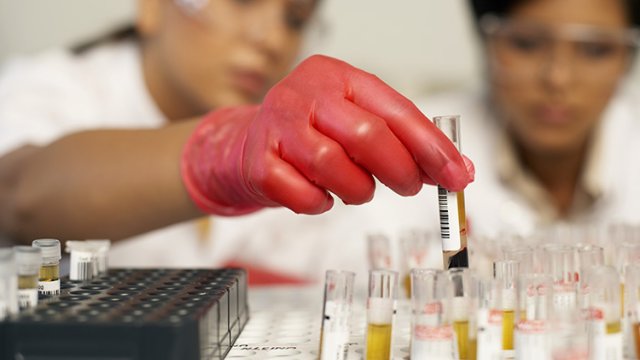
NCER's mission is to support high-quality research by the nation's leading scientists that will improve EPA’s scientific basis for decisions on national environmental issues. NCER supports leading edge extramural research in exposure, effects, risk assessment, and risk management through competitions for STAR grants, fellowships, and research contracts under the Small Business Innovative Research Program. Learn More
Top Stories
Could Preserving Biodiversity Reduce Disease? EPA Funds $2.25 Million to Research Connections
EPA has awarded three grants, totaling $2.25 million, to support research programs working to better understand and characterize the mechanisms that link environmental stressors, such as deforestation and climate change, to the loss of biodiversity and the transmission of infections diseases to people.
[Read More]
Summer 2008: Time to GRO
This summer, 15 undergraduate EPA Fellows will be protecting the environment while gaining valuable career experience—all part of EPA’s Greater Research Opportunities (GRO) Fellowship Program.
[Read More]
Green Scene: Green Buildings
Dr. Bill Sanders, Director of EPA's National Center for Environmental Research, discusses the growing field of "Green Building" and what you can do to improve the environmental performance of your home or building.
[Watch Video | Read More]
NACEPT Report Recommends Actions for EPA to Achieve More Private
Sector Investment in Environmental Technologies
The National Advisory Council for Environmental Policy and Technology (NACEPT), (an independent advisory committee to EPA), has released a new report identifying actions that EPA and the investment community can take to increase private sector investment in developing new environmental technologies necessary to combat climate change.
[Read More]
Small Businesses Tackle Big Environmental Issues
The U.S. Environmental Protection Agency (EPA) announced $1.6 million in funding for seven small companies to commercialize green technologies.
[Read More]
Novel Approaches for Assessing Exposure for School-Aged Children in Longitudinal Studies
The U.S. Environmental Protection Agency (EPA), as part of its Science to Achieve Results (STAR) program, is seeking applications proposing research to identify novel, innovative, quantitative, low-cost, low burden methods and approaches to classify exposures for children as they age and begin to spend more time in places outside the home such as child care locations, schools and playgrounds.
[Read More]
The U.S. Environmental Protection Agency (EPA), as part of its Science to Achieve Results (STAR) program, is seeking applications proposing research to identify novel, innovative, quantitative, low-cost, low burden methods and approaches to classify exposures for children as they age and begin to spend more time in places outside the home such as child care locations, schools and playgrounds.
[Read More]
Forecasting Ecosystem Services from Wetland Condition Analyses
The U.S. Environmental Protection Agency (EPA), as part of its Science to Achieve Results (STAR) program, is seeking applications to develop relationships between wetland ecological condition indicators and ecosystem services delivery.
[Read More]
The U.S. Environmental Protection Agency (EPA), as part of its Science to Achieve Results (STAR) program, is seeking applications to develop relationships between wetland ecological condition indicators and ecosystem services delivery.
[Read More]
EPA has awarded three grants, totaling $2.25 million, to support research programs working to better understand and characterize the mechanisms that link environmental stressors, such as deforestation and climate change, to the loss of biodiversity and the transmission of infections diseases to people.
[Read More]
Adaptation for Future Air Quality Analysis and Decision Support Tools in Light of Global Change Impacts and Mitigation
The U.S. Environmental Protection Agency (EPA), as part of its Science to Achieve Results (STAR) program, is seeking applications proposing research to better understand the interplay of climate factors and air pollution regulatory requirements on air quality outcomes.
[Read More]
The U.S. Environmental Protection Agency (EPA), as part of its Science to Achieve Results (STAR) program, is seeking applications proposing research to better understand the interplay of climate factors and air pollution regulatory requirements on air quality outcomes.
[Read More]
Climate Change and Allergic Airway Disease
The U.S. Environmental Protection Agency (EPA), as part of its Science to Achieve Results (STAR) program, is seeking applications proposing research on the impact of global change on the development and severity of allergic airway disease from exposure to pollen, mold, and other plant-derived allergens.
[Read More]
The U.S. Environmental Protection Agency (EPA), as part of its Science to Achieve Results (STAR) program, is seeking applications proposing research on the impact of global change on the development and severity of allergic airway disease from exposure to pollen, mold, and other plant-derived allergens.
[Read More]
Summer 2008: Time to GROThis summer, 15 undergraduate EPA Fellows will be protecting the environment while gaining valuable career experience—all part of EPA’s Greater Research Opportunities (GRO) Fellowship Program.
[Read More]
Dr. Bill Sanders, Director of EPA's National Center for Environmental Research, discusses the growing field of "Green Building" and what you can do to improve the environmental performance of your home or building.
[Watch Video | Read More]
The National Advisory Council for Environmental Policy and Technology (NACEPT), (an independent advisory committee to EPA), has released a new report identifying actions that EPA and the investment community can take to increase private sector investment in developing new environmental technologies necessary to combat climate change.
[Read More]
The U.S. Environmental Protection Agency (EPA) announced $1.6 million in funding for seven small companies to commercialize green technologies.
[Read More]
Upcoming Events
- EPA Region 2 ETV-SBIR Workshop - October 7 - 8, 2008
- International Environmental Nanotechnology Conference: Applications and Implications - October 7 - 9, 2008
- Interagency Environmental Nanotechnology Grantees Workshop - November 19 - 21, 2008
![[logo] US EPA](http://www.epa.gov/epafiles/images/logo_epaseal.gif)