U.S. flag

An official website of the United States government

Here’s how you know

Dot gov

Official websites use .gov
A .gov website belongs to an official government organization in the United States.

HTTPS

Secure .gov websites use HTTPS
A lock (LockA locked padlock) or https:// means you’ve safely connected to the .gov website. Share sensitive information only on official, secure websites.

    • Environmental Topics
    • Air
    • Bed Bugs
    • Chemicals, Toxics, and Pesticide
    • Emergency Response
    • Environmental Information by Location
    • Health
    • Land, Waste, and Cleanup
    • Lead
    • Mold
    • Radon
    • Research
    • Science Topics
    • Water Topics
    • A-Z Topic Index
    • Laws & Regulations
    • By Business Sector
    • By Topic
    • Compliance
    • Enforcement
    • Guidance
    • Laws and Executive Orders
    • Regulations
    • Report a Violation
    • Environmental Violations
    • Fraud, Waste or Abuse
    • About EPA
    • Our Mission and What We Do
    • Headquarters Offices
    • Regional Offices
    • Labs and Research Centers
    • Planning, Budget, and Results
    • Organization Chart
    • EPA History

Breadcrumb

  1. Home
  2. International Cooperation

Reducing Mercury Pollution from Artisanal and Small-Scale Gold Mining

Tools to Reduce Mercury from Artisanal and Small-Scale Gold Mining
  • Artisanal and Small-Scale Gold Mining Without Mercury: Explore techniques to mine gold without using mercury.
  • Gold Shop Mercury Capture System (PDF) (1 pp, 207 K, About PDF), featured in the ASGM Community Library  (hosted by UN Environment)
  • Watch a video  explaining how to reduce mercury emissions using the Mercury Capture System.
  • Explore a Technology Demonstration for Reducing Mercury Emissions from Small-Scale Gold Refining Facilities (PDF)(84 pp, 2.58 M, About PDF)  
  • Mercury Capture System highlighted at Phys.org,  a leading web-based science, research and technology news service. 
  • Explore activities under the UNEP Global Mercury Partnership 

Mercury has long been used in artisanal and small-scale gold mining (ASGM) to extract gold from ore sediment and rock deposits. ASGM accounts for more than a third (38%) of all anthropogenic mercury emissions to the atmosphere, with most ASGM sector-related mercury emissions coming from the burning of mercury-gold amalgam. Around the world, tens of millions of workers engage in the ASGM sector, producing up to 20% of the world’s gold annually. Gold from the ASGM sector is sold into global supply chains to satisfy demand for jewelry, investment purposes, central bank reserves, and technology/electronics.

  • More information on Health Effects of Exposures to Mercury.
  • Learn more about International Actions for Reducing Mercury Emissions and Use.

A Focus on Gold Shops

Video: Learn how EPA's mercury capture system is helping reduce mercury in gold shops.
 
In many communities, gold shops are a key component linking miners and local traders to the ASGM gold supply chain. Gold shops play an important role in the artisanal gold production and commercial processes and are also commonly involved in mercury trade for use in ASGM.  Studies have found emissions from gold shops pose a major hazard both in terms of indoor concentrations and in the form of emissions to community residents in the vicinity of the gold shops, with levels of mercury far exceeding recommended levels. The impact of these emissions extend beyond the immediate area as the mercury emissions can be deposited and cycled to destinations far from the source.
 

Mercury Capture Systems: 

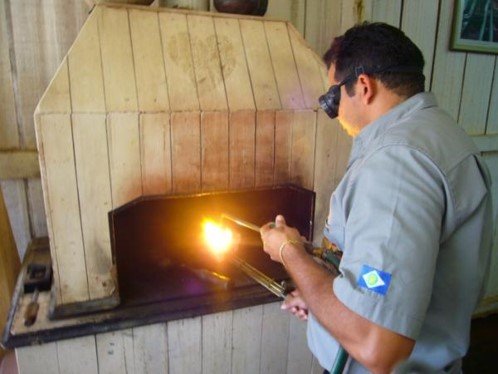
A gold shop worker burns the mercury-gold amalgam to evaporate mercury, resulting in more purified gold doré.

From 2005-2010, EPA led efforts in collaboration with U.S. Department of Energy’s Argonne National Laboratory (ANL) to develop a system capable of capturing mercury at the emission source to reduce gold shop-related emissions from amalgam burning as a near-term option for reducing ASGM emissions. The resulting Mercury Capture System (MCS) was designed to provide a simple system that is highly effective in capturing mercury, and inexpensive and easy to construct using locally available materials.

While complete elimination of mercury from ASGM is the ultimate goal, in the near-term significant emissions reductions can be achieved if mercury is captured during amalgam burns. By limiting the path of mercury release into the environment, the captured mercury can instead be redirected for re-use or appropriate storage and eventual disposal. 

Please note: Since the initial rollout of the MCS, EPA is aware of other efforts to make even more efficient mercury capture systems and is seeking to better understand these efforts, with the hope of sharing that information in the future. 


Contact

For more information, please contact:

Andrew Reighart
U.S. Environmental Protection Agency
Office of International and Tribal Affairs  (2610T)
1200 Pennsylvania Ave., NW
Washington, DC 20460
Email: reighart.andrew@epa.gov

International Cooperation

  • Where We Work
  • Resources
  • Schedule a Visit
Contact Us about International Cooperation
Contact Us about International Cooperation to ask a question, provide feedback, or report a problem.
Last updated on January 23, 2026
  • Assistance
  • Spanish
  • Arabic
  • Chinese (simplified)
  • Chinese (traditional)
  • French
  • Haitian Creole
  • Korean
  • Portuguese
  • Russian
  • Tagalog
  • Vietnamese
United States Environmental Protection Agency

Discover.

  • Accessibility Statement
  • Budget & Performance
  • Contracting
  • EPA www Web Snapshot
  • Grants
  • No FEAR Act Data
  • Plain Writing
  • Privacy and Security Notice

Connect.

  • Data
  • Inspector General
  • Jobs
  • Newsroom
  • Regulations.gov
  • Subscribe
  • USA.gov
  • White House

Ask.

  • Contact EPA
  • EPA Disclaimers
  • Hotlines
  • FOIA Requests
  • Frequent Questions
  • Site Feedback

Follow.