U.S. flag

An official website of the United States government

Here’s how you know

Dot gov

Official websites use .gov
A .gov website belongs to an official government organization in the United States.

HTTPS

Secure .gov websites use HTTPS
A lock (LockA locked padlock) or https:// means you’ve safely connected to the .gov website. Share sensitive information only on official, secure websites.

    • Environmental Topics
    • Air
    • Bed Bugs
    • Chemicals, Toxics, and Pesticide
    • Emergency Response
    • Environmental Information by Location
    • Health
    • Land, Waste, and Cleanup
    • Lead
    • Mold
    • Radon
    • Research
    • Science Topics
    • Water Topics
    • A-Z Topic Index
    • Laws & Regulations
    • By Business Sector
    • By Topic
    • Compliance
    • Enforcement
    • Guidance
    • Laws and Executive Orders
    • Regulations
    • Report a Violation
    • Environmental Violations
    • Fraud, Waste or Abuse
    • About EPA
    • Our Mission and What We Do
    • Headquarters Offices
    • Regional Offices
    • Labs and Research Centers
    • Newsroom
    • Planning, Budget, and Results
    • Organization Chart
    • EPA History

Breadcrumb

  1. Home
  2. Global Change Explorer (GCX)

About ICLUS

On this page:

  • About ICLUS
  • Publications

Climate and land-use change are major drivers of global environmental change. Impact assessments frequently demonstrate that interactions between climate and land-use change may create serious challenges for aquatic ecosystems, water quality, and air quality. In many cases, it is impossible to assess the impact of climate change without consideration of population dynamics, land use dynamics, or both.

The Integrated Climate and Land Use Scenarios (ICLUS) project produced spatially explicit projections of population and land-use that are based on Intergovernmental 
Panel on Climate Change’s (IPCC) scenarios and pathways.
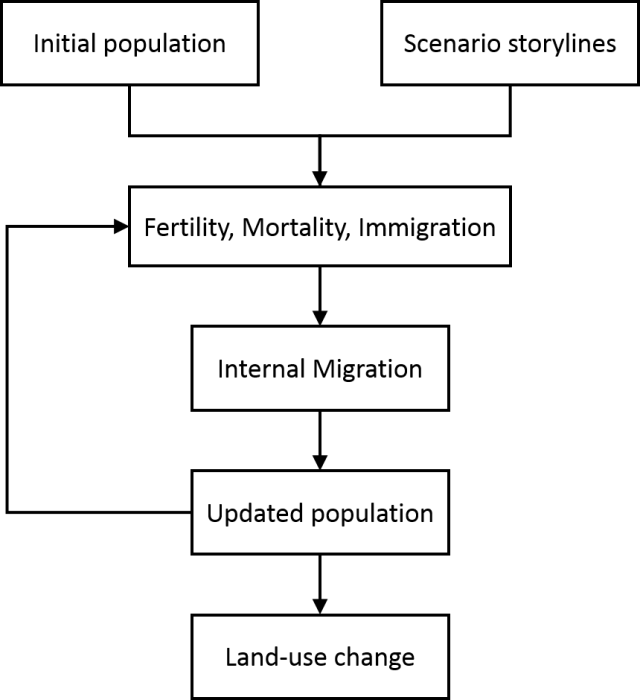
Flow diagram showing the demographic storyline or population pathway to impervious services.

First, social, economic, and demographic storylines were adapted for the United States. These modified storylines were then used to create population projections that would reflect different assumptions about fertility, mortality, and immigration through the end of this century.

Next, a spatial interaction model was used to simulate the annual movement of people within the United States. Then the results of these population projections are used to calculate the demand for new residential lands.


Publications

EPA Reports

  • Updates to the Demographic and Spatial Allocation Models to Produce Integrated Climate and Land Use Scenarios (ICLUS) (Version 2) (Final Report)
  • Land-Use Scenarios: National-Scale Housing-Density Scenarios Consistent with Climate Change Storylines (Final Report)

Datasets/Metadata

  • ICLUS Downloads

Journal Articles

  • Urban adaptation can roll back warming of emerging megapolitan regions. 2014. Proceedings of the National Academy of Sciences 111(8): 2909-2914. 
  • Climate Change-Related Temperature Impacts on Warm Season Heat Mortality: A Proof-of-Concept Methodology Using BenMAP. 2011. Environmental Science & Technology 45(4): 1450-1457. DOI: 10.1021/es102820y.
  • National housing and impervious surface scenarios for integrated climate impact assessments. 2010. Proceedings of the National Academy of Sciences 107(49): 20887-20892.
  • Variation in estimated ozone-related health impacts of climate change due to modeling choices and assumptions. 2011. Environmental Health Perspectives 120(1): 1559-1564.
  • Using ICLUS v2 to Characterize Global Change Impacts, Vulnerabilities, and Adaptation Opportunities (Presentation). Washington, DC, 2018.

Global Change Explorer (GCX)

  • Atmospheric Depostion
  • Coastal Areas
    • Adaptation Design for Coral Reef Restoration
    • Adaptation Design Tool
    • Delaware Bay Wetland Projections
    • SEATool
  • Land Use
  • Climate Scenarios
  • Climate Resilience
  • Watersheds
Contact Us about GCX
Contact Us about GCX to ask a question, provide feedback, or report a problem.
Last updated on November 24, 2026
  • Assistance
  • Spanish
  • Arabic
  • Chinese (simplified)
  • Chinese (traditional)
  • French
  • Haitian Creole
  • Korean
  • Portuguese
  • Russian
  • Tagalog
  • Vietnamese
United States Environmental Protection Agency

Discover.

  • Accessibility Statement
  • Budget & Performance
  • Contracting
  • EPA www Web Snapshot
  • Grants
  • No FEAR Act Data
  • Plain Writing
  • Privacy and Security Notice

Connect.

  • Data
  • Inspector General
  • Jobs
  • Newsroom
  • Regulations.gov
  • Subscribe
  • USA.gov
  • White House

Ask.

  • Contact EPA
  • EPA Disclaimers
  • Hotlines
  • FOIA Requests
  • Frequent Questions
  • Site Feedback

Follow.