


Bubbly Creek Sampling
On this page:
Background
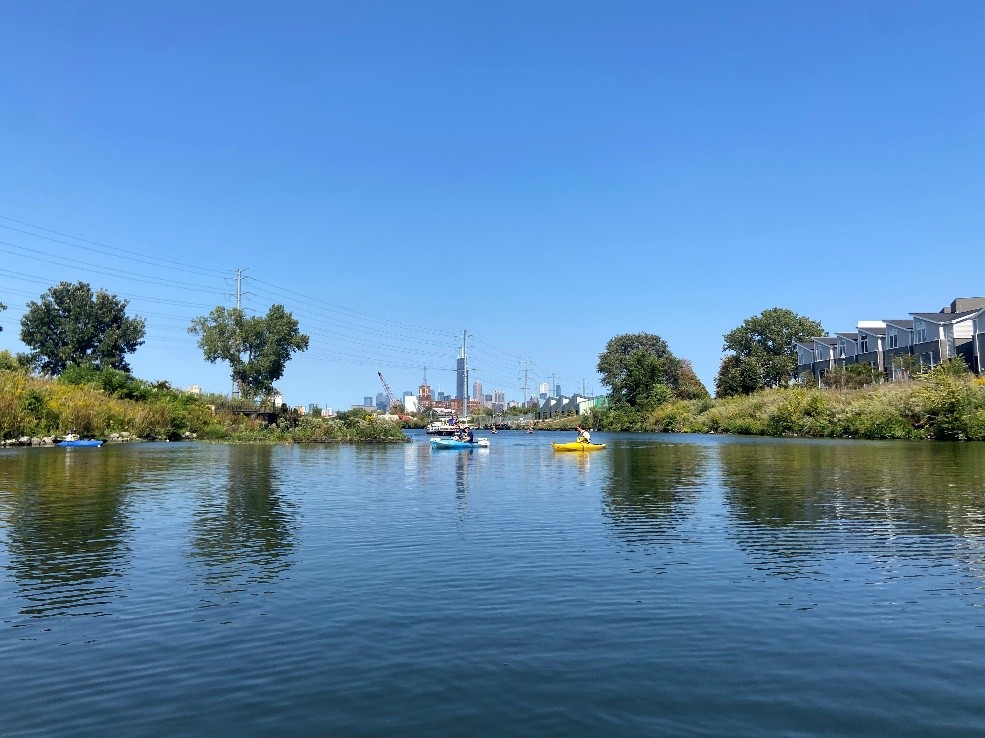
Bubbly Creek is a section of the Chicago River on the city’s south side near the Bridgeport and McKinley Park neighborhoods. Historically, the creek had been a pristine prairie slough that provided habitat for fish and wildlife, including reptiles and migratory birds.
As Chicago’s population grew in the late 1800s, various industries settled along the river, with meatpacking and stockyards concentrated along the creek. Unregulated waste disposal polluted the creek beyond recognition. The channel was deepened and widened, the wetland was filled in, sewage was released into the creek, and the sediment was contaminated with heavy metals, polycyclic aromatic hydrocarbons (PAHs), and polychlorinated biphenyls (PCBs). Famously, the creek began to bubble due to the contamination, which led to its nickname and the creek being featured in Upton Sinclair’s The Jungle.
The creek was also part of the Peoples Gas Pitney Court Former MGP Superfund alternative site. The site has since been removed from the federal Superfund program.
Informing Future Habitat Restoration
Work is currently underway to assess Bubbly Creek. In 2020, the U.S. Army Corps of Engineers produced a National Ecosystem Restoration feasibility study recommending a comprehensive 40-acre habitat restoration plan. EPA, with USACE and the City of Chicago, is taking the initial steps to advance this ecosystem restoration through a pre-design investigation to assess data gaps, characterize sediment contamination, and inform future actions.
EPA completed a field sampling plan, which has been reviewed by USACE, the City of Chicago, Metropolitan Water Reclamation District of Greater Chicago, and Illinois EPA. The plan guides the sampling work to be performed in the creek. Final reports are estimated to be ready in the fall of 2027.
Bubbly Creek has nine Combined Sewer Overflow (CSO) outfalls. While CSO discharges will continue in the creek, they are expected to decrease significantly in frequency and volume after the McCook Reservoir Stage 2 comes online as part of MWRD’s Tunnel and Reservoir Plan in 2032. All sampling efforts will be coordinated around CSO discharge events.
Progress
For three weeks this summer, EPA will take samples from a boat in the creek. Sampling is targeted for July/August and is subject to change based on weather and contractor coordination. Next spring, EPA will return to retrieve the sampling equipment.
EPA is leading and funding this investigation through the Great Lakes Restoration Initiative, a multi-agency program led by EPA that is devoted to restoring and protecting the Great Lakes.
In 2022, Urban Rivers and its partners implemented floating islands that serve as wetland habitat. The habitat also provides some improvement to water quality through filtration.
