


Reducing Mercury Pollution from Artisanal and Small-Scale Gold Mining
Mercury has long been used in artisanal and small-scale gold mining (ASGM) to extract gold from ore sediment and rock deposits. ASGM accounts for more than a third (38%) of all anthropogenic mercury emissions to the atmosphere, with most ASGM sector-related mercury emissions coming from the burning of mercury-gold amalgam. Around the world, tens of millions of workers engage in the ASGM sector, producing up to 20% of the world’s gold annually. Gold from the ASGM sector is sold into global supply chains to satisfy demand for jewelry, investment purposes, central bank reserves, and technology/electronics.
- More information on Health Effects of Exposures to Mercury.
- Learn more about International Actions for Reducing Mercury Emissions and Use.
A Focus on Gold Shops
Mercury Capture Systems:
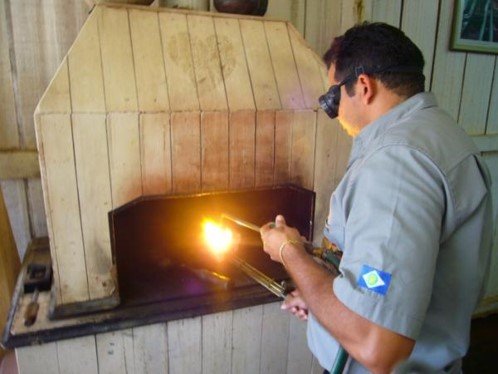
From 2005-2010, EPA led efforts in collaboration with U.S. Department of Energy’s Argonne National Laboratory (ANL) to develop a system capable of capturing mercury at the emission source to reduce gold shop-related emissions from amalgam burning as a near-term option for reducing ASGM emissions. The resulting Mercury Capture System (MCS) was designed to provide a simple system that is highly effective in capturing mercury, and inexpensive and easy to construct using locally available materials.
While complete elimination of mercury from ASGM is the ultimate goal, in the near-term significant emissions reductions can be achieved if mercury is captured during amalgam burns. By limiting the path of mercury release into the environment, the captured mercury can instead be redirected for re-use or appropriate storage and eventual disposal.
Please note: Since the initial rollout of the MCS, EPA is aware of other efforts to make even more efficient mercury capture systems and is seeking to better understand these efforts, with the hope of sharing that information in the future.
Contact
For more information, please contact: