


EPA Lead (Pb) Research: Land and Legacy
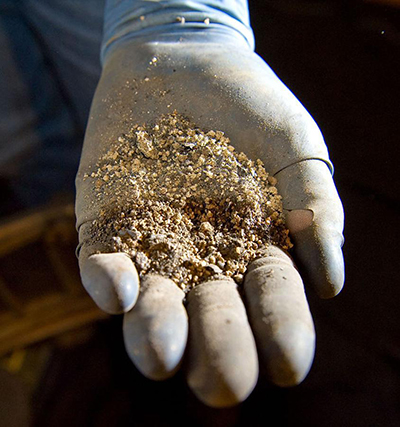
EPA researchers explored how the presence of lead in Superfund and other contaminated sites can impact exposure and related health risks. Their work, such as exploring how to keep landfills safe from lead leachate and developed innovative new techniques to assess the bioavailability of lead in soil, supports environmental remediation and clean-up efforts that are protecting public health and returning formerly contaminated land back into community assets.
Agency researchers also worked to support remediation and cleanup efforts that target “legacy” lead pollution—contamination that remains in the environment from past practices such as lead processing (smelting), mining activities, and the use and production of lead paint and gasoline. Such pollution can still contribute to contaminated dust and soils that can lead to exposure risks.
Examples of how EPA researchers supported efforts to reduce lead exposure risks from land and soil are highlighted below.
Developed New Methods for Assessing Lead in Soil
EPA researchers have developed and validated an innovative methodology—based on a “virtual stomach” that mimics human digestion—to guide the cleanup of contaminated soils. The new laboratory method estimated the bioavailability of lead and arsenic in ways that increase the accuracy of human health risk assessments and offered the potential to dramatically reduce remediation costs. Read more in New Testing Method for Lead and Arsenic in Contaminated Soil Saves Money and Protects Public Health.
EPA Research Guided Soil Remediation in Omaha, Nebraska
For more than 125 years, the American Smelting and Refining Company operated a lead refinery in Omaha, Nebraska, only a few blocks west of the Missouri River. Large amounts of lead were emitted into the air, contaminating the surrounding neighborhoods. EPA researchers worked in partnership with EPA Region 7 and local public health officials to help guide soil remediation and cleanup efforts that reduced lead exposure to children and others living in the area. Read more in Reducing Children’s Lead Exposure in Omaha, Nebraska.
RARE Research Matched Lead Research Experts to Local Needs
EPA’s Regional Applied Research Effort (RARE) program partnered with Agency scientists and engineers and with colleagues from each of EPA’s ten regional offices in ways that leveraged their collective technical expertise to meet high priority, local environmental challenges. In addition to delivering locally-based solutions, the program provided EPA scientists and support staff with valuable insight into science needs of regional offices and the local communities they served. Several projects have been funded to address concerns about lead contamination. They included:
- Innovative Ways to Keep Landfills Safe from Lead Leachate
Worked with partners from EPA Region 6, which encompasses Arkansas, Louisiana, New Mexico, Oklahoma, Texas and 66 Tribes, researchers explored the long-term efficacy of treating lead-waste from automotive recycling, foundry sands, the disposal of old computer monitors, and other sources with phosphate to prevent lead from leaching into the soil once it is sent to solid waste landfills. Results provided a clearer understanding of the mechanisms involved with phosphate treated wastes and help EPA’s Office of Emergency and Land Management and local communities handle such wastes.
- Soil Amendments for Remote and Sensitive Sites
Worked with partners in EPA Region 10, which encompasses Alaska, Idaho, Oregon, Washington, and 271 Native Tribal Nations to investigate the use of soil amendments to reduce the bioavailability and bioaccessibility of lead in abandoned hard rock mines and other contaminated sites across the area. The results provided a science-based recommendation of minimal impact soil amendment techniques used to reduce lead bioavailability for sites sensitive to heavy loadings of soil amendments and sites that cannot be physically mixed or disturbed.
- New Ways to Identify the Source of Lead Contamination
A key component of addressing and remediating lead contamination is pinpointing where it came from. Worked with local Superfund managers and EPA Region 7 (Nebraska, Iowa, Kansas, Missouri, and Nine Tribal Nations), Agency researchers explored the use of isotopic lead ratio analysis to determine what portion of contamination at Superfund sites is attributable to mining-related or other industrial sources versus anthropogenic or natural sources, and if those sources be effectively differentiated.