


Fraud Alert: Romance Schemes
The U.S. Environmental Protection Agency Office of Inspector General is issuing this fraud alert to highlight an increasingly common and costly form of cybercrime involving social media, dating websites, or email. Through these electronic means, fraudsters use fake profiles to contact elderly people or others who they believe are not tech-savvy. The fraudsters present themselves as individuals in remote locations with little access to a phone or the internet. Over time, the fraudsters develop romantic relationships with their victims and eventually tell their victims phony backstories about how they need to be monetarily “rescued.”
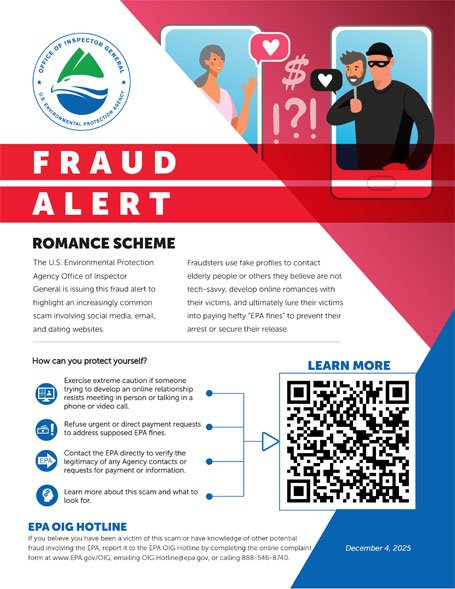
For example, in an EPA-related version of this scam, a fraudster may describe facing EPA fines in connection with an environmental disaster. The fraudster recruits the victim to assist as a “mediator” between the fraudster and the “ostensible EPA.” Soon after, the victim begins receiving emails with the EPA logo and signature block that appear to be from legitimate EPA representatives. The imposter EPA representatives gradually increase the urgency of the emails, such as threatening to put the fraudster in prison for lack of payment. The imposter EPA representatives then pressure the victim into paying part of the fine, at times totaling hundreds of thousands of dollars or more, to prevent the arrest or secure the release of the fraudster.
According to the Federal Trade Commission, Americans lost over $1.2 billion in 2022 alone to scams that originated on social media platforms. Additionally, in 2023, the Federal Trade Commission received over 64,000 reports of romance scams, totalling over $1.1 billion in losses. The loss amounts and types of scams continue to escalate. In newly released data by the Federal Trade Commission, the losses under fraud scams increased to more than $12.5 billion in 2024.
How do you protect yourself from romance scams?
- If you receive unusual contacts from friends or family members through social media or email, contact them through another method, such as a phone call, to confirm the authenticity of the communication.
- Be wary and exercise extreme caution if the contact is not willing to talk on the phone or meet in person or via a video chat. Fraudsters commonly stall scheduling phone calls or video calls and often refuse to meet in person. If a call does take place, the fraudster’s accent often does not match the background of the person being impersonated.
- Beware of urgent requests. Fraudsters introduce a storyline tied to an urgent financial situation to motivate a victim to act quickly before the victim can confirm or dispute the story.
- Do not send money through methods that make recovery difficult, such as wires, gift cards, or cryptocurrency. Fraudsters will also send links to facilitate a money transfer, or they may send harmful links that contain malicious software.
How do you avoid losing your money?
- If you suspect a scam, stop communicating with the person immediately.
- Do not click links, especially if someone sent the link and directed you to log into an existing financial account. This scam will mimic your actual account page and is used to record your login information.
- Be cautious of unsolicited offers involving the EPA and contact the Agency directly to verify the legitimacy of any contacts or request you receive.
- If you think you have been the victim of a financial scam, immediately contact your bank, the social media or dating website where you interacted with the fraudster, the government agency allegedly represented in the scam, and either the Federal Trade Commission at ReportFraud.ftc.gov or the Federal Bureau of Investigation’s Internet Crime Complaint Center at www.ic3.gov.
If you think you have been the victim of a scam involving the EPA, report the incident to the EPA OIG Hotline by completing the online complaint form at https://www.epa.gov/office-inspector-general/forms/epa-oig-hotline-complaint-form, emailing OIG.Hotline@epa.gov, or calling (888) 546-8740.