


Battery Collection in Action Case Study: Vape Aware: E-Cigarette Collection in Boulder County, Colorado
On this page:
Introduction

The Boulder County Hazardous Materials Management Facility, Boulder County Public Health, and Tobacco Education and Prevention Program are tackling e-cigarette collection and disposal through their Vape Aware program. Vape Aware partners with school districts and vape shops to provide free e-cigarette collection bins and educational materials for safe e-cigarette disposal. In addition to serving Boulder County and its two school districts, Boulder Valley and St. Vrain Valley, the program serves Jefferson County School District, the city and County of Broomfield, and the town of Erie due to their proximity and regular use of the Boulder County Hazardous Materials Management Facility. Home to over 330,000 people, Boulder County is geographically varied, spanning portions of the Rocky Mountains, suburban communities and the city of Boulder.
In 2017, a rising number of e-cigarettes began appearing at the Boulder County Hazardous Materials Management Facility and accumulating in schools, which mirrored national trends in increased e-cigarette use. Despite the growing popularity of e-cigarettes, many state and local governments lack standardized outreach and disposal programs, leading many consumers to discard their e-cigarettes in their household trash. Boulder County’s school districts have a tobacco-free policy, which requires schools to confiscate e-cigarettes and other tobacco devices if students are caught with them. As schools accumulated more e-cigarettes, the district needed educational materials and collection resources to support staff in safely handling and disposing of the devices.
When improperly managed at their end of life, e-cigarettes and their components—lithium batteries and nicotine cartridges, e-liquids or pods—can pose severe risks to the environment, public health and worker safety. E-liquids are considered hazardous waste under the Resource Conservation and Recovery Act because they contain nicotine, which is toxic to humans and animals even in small doses. Additionally, when lithium batteries are placed in household trash or recycling, they can ignite during trash compaction, which damages waste vehicles, facilities and the environment.
Program Design and Implementation
Household Hazardous Waste Retail Collection Bins
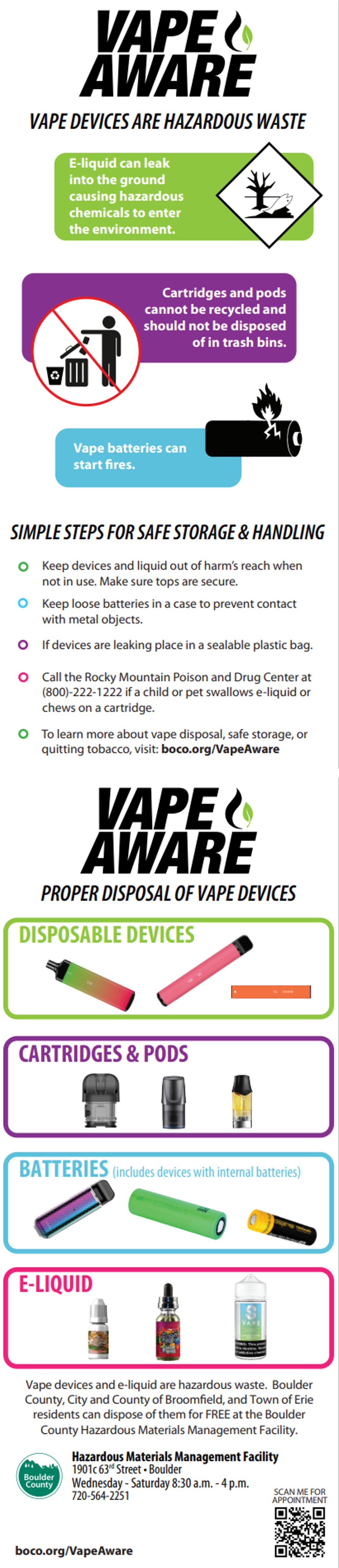
Vape Aware’s first initiative was creating an educational card to show on vape display stands, which they designed for customers to view on retail displays.
The rack display card provides consumers with basic information on hazardous waste, the dangers of disposal of e-cigarettes in municipal trash and recycling, steps for safe storage and handling and images of e-cigarettes and their components. In addition to the rack card, the Boulder County Hazardous Materials Management Facility provides vape shops with plastic collection bins and personal protective equipment to help retailers safely collect e-cigarettes from customers.
The Boulder County Hazardous Materials Management Facility learned from vape shops that transporting collected e-cigarettes to the facility was a barrier to collection due to the logistics and time requirements of transport. As a result, the Boulder County Hazardous Materials Management Facility decided to contract with Ridwell, a household hazardous waste collection service, to conduct monthly pickups from vape shops to transport vapes to the facility for processing.
Transportation Support in Mountain Communities
Vape shops in mountain communities may be far from the Boulder County Hazardous Materials Management Facility and the city of Boulder. As a result, the facility arranged for mountain town transfer station staff to collect e-cigarettes at the transfer stations and from their local vape shops and to transport them to the facility during their trips to Boulder.
School District Hazardous Waste Collection Resources
During Vape Aware’s early years, staff and administrators from Boulder Valley School District’s middle and high schools approached the Boulder County Hazardous Materials Management Facility for help with managing confiscated e-cigarettes and setting up collection systems, without triggering all the requirements of a regulated hazardous waste-generating site. The Boulder County Hazardous Materials Management Facility, Boulder County Public Health, and Tobacco Education and Prevention Partnership have since partnered to create hazardous waste collection bins and educational materials for schools. The Boulder County Hazardous Materials Management Facility provides schools with kits that include:
- Two-gallon plastic collection bins outfitted with “fill line” stickers.
- Clear plastic bags for leaking or damaged devices to prevent battery terminalsTerminals are the external connections to a battery’s internal nodes. They may be at the ends on some batteries, but they can also be on the top, side, or as a connector depending on the battery design. from touching.
- A hazardous waste label.
- Latex or nitrile gloves.
- An informational toolkit on using the collection kit and understanding the environmental and health hazards of e-cigarettes.
The fill line sticker corresponds with approximately 2.2 pounds of collected e-cigarettes—a Resource Conservation and Recovery Act threshold. To prevent students from reaching the devices, Vape Aware trains school staff to store the collection bins in locked file cabinets or other secure areas. The fill line stickers prevent schools from exceeding regulatory hazardous waste thresholds. Once the collected e-cigarettes reach the bin’s fill line, the sticker instructs schools to call the district environmental services team, who will collect and transport the containers to the Boulder County Hazardous Materials Management Facility for sorting and processing. The facility allows schools to drop off collected e-cigarettes weekly by appointment.
Sorting and Preparing for Shipment

After the Boulder County Hazardous Materials Management Facility receives e-cigarettes from schools and vape shops, it sorts the devices into Boulder County Hazardous Materials Management Facility buckets for:
- Nicotine (e.g., e-liquids and pods).
- Separated batteries.
- E-cigarette devices.
Once e-cigarette waste accumulates at the Boulder County Hazardous Materials Management Facility for six to 10 weeks, the facility ships its hazardous waste to Veolia, an environmental services and waste management company, for incineration. This accumulation timeframe aligns with hazardous waste accumulation time limits in regulations. If staff can easily remove batteries from the e-cigarettes, the Boulder County Hazardous Materials Management Facility recycles them.
Since 2017, Vape Aware has expanded to more schools and increased its partnerships with community organizations and health departments. In 2020, the program created toolkits for schools (pdf) and for community organizations and health departments (pdf). These toolkits include resources to guide proper e-cigarette collection and disposal, sample communication materials and messaging, and tips for schools and organizations that are interested in establishing their own e-cigarette collection programs.
Funding
Seven full-time Boulder County Hazardous Materials Management Facility staff, including two employees who work exclusively on the e-cigarette program, support Vape Aware.
Vape Aware is financed primarily through the Boulder County General Fund and Colorado Department of Public Health and Environment’s innovation grant, which covers program staffing, e-cigarette policy research and media campaigns. The program initially received between $5,000 and $7,000 from Boulder County’s sustainable tax fund to help offset the costs of collection supplies for vape shops and schools. However, this funding to Vape Aware has ended, leaving Vape Aware more reliant on Boulder County’s General Fund.
E-cigarette transportation, shipping and incineration make up the program’s largest expenses, accounting for approximately 65 percent of program costs. Outreach and education campaigns and collection supplies and services make up 15 percent and 20 percent of Vape Aware’s budget, respectively.
Retail Collection Sites
Because consumer e-cigarettes collected by vape shops are household hazardous waste, Vape Aware covers the cost of transportation, e-cigarette management at the Boulder County Hazardous Materials Management Facility and incineration.
Schools
The high cost of managing e-cigarette waste creates significant financial barriers—especially for lower-income schools. Schools pay $20 per pound for e-cigarette management at the Boulder County Hazardous Materials Management Facility. The cost of processing e-cigarette waste creates significant financial barriers, especially for lower-income schools. The Product Stewardship Institute estimates that each vape collected costs the Boulder County Hazardous Materials Management Facility around $1.50 for management and disposal.
Insights and Next Steps
Since Vape Aware began in 2017, Boulder County has worked to expand its e-cigarette collection network and set an example for other communities. Shelly Fuller, the former Hazardous Materials Program Manager at the Boulder County Hazardous Materials Management Facility, believes the program has succeeded through finding “local champions”—community partners that are excited and willing to take on e-cigarette collection. The Boulder County Hazardous Materials Management Facility offers free collection bins, supplies, outreach materials and disposal, which may make retailers and community partners more inclined to set up collection sites. For the long-term success of an e-cigarette collection program, Fuller emphasized the importance of finding secure sources of funding, conducting consistent outreach with collection site partners and understanding the transportation and financial barriers of a community.
Challenges Encountered
- Cost. E-cigarette disposal is expensive. Additionally, some Boulder County vape retailers own shops in other counties and bring their out-of-county vape waste to their shops in Boulder County for collection and management. This has raised costs and strained limited collection capacity for the Boulder County Hazardous Materials Management Facility due to the quantity of e-cigarettes.
- Competing priorities. Schools often face competing priorities and may lack the time or interest to focus on collecting e-cigarettes.
- Employee turnover. Changes in staff at schools and vape shops can disrupt collection knowledge and processes.
- Geographic barriers. Residents of mountain communities may live far from collection sites.
- Product design. Most e-cigarette batteries are embedded, preventing the Boulder County Hazardous Materials Management Facility from removing them for recycling. E-cigarette designs constantly evolve, which can lead to outreach materials quickly becoming outdated.
Evaluation Metrics
Vape Aware uses a variety of performance measures to track e-cigarette collection in Boulder County. The program measures the number of devices, pods and e-liquid collected; weight of collected materials; number of shops and schools with collection sites; and the number of drop-offs at the Boulder County Hazardous Materials Management Facility per year. In 2024, the Boulder County Hazardous Materials Management Facility received 13,154 devices, including 41 pounds of pods and e-liquid—a sharp increase from the 7,706 devices collected in 2023. Between 2023 and 2024, Vape Aware collection bins expanded from 49 to 78 schools, and 13 to 21 vape shops.
What Works Well
- Establishing strong partnerships between government organizations and collection partners. Vape Aware has succeeded in establishing its e-cigarette collection and disposal network through strong collaboration with the Boulder County Hazardous Materials Management Facility, Boulder County Public Health, and Tobacco Education and Prevention Partnership. These partnerships have allowed Vape Aware to create resources about the public health, environmental and safety implications of improper e-cigarette disposal.
- Providing consistent outreach and communication with collection partners to gain community trust. Since the start of the program, Vape Aware has continued to reach out to school districts, community organizations and vape shops to determine how best to support them. Open and consistent communication also helps Vape Aware track the fullness of collection bins and whether sites are actively using them, keeping the program active.
- Adapting to the needs of partners. Many of Boulder County’s mountain communities live far from hazardous waste collection sites or are hesitant to drop off their devices because of the stigma surrounding e-cigarette use. To address this challenge, the Boulder County Hazardous Materials Management Facility decided to partner with mountain town transfer stations, whose staff are experts on the waste and recycling needs in their communities. Together, they developed a plan for transfer stations to pick up collected e-cigarettes from vape shops and deliver the waste to the Boulder County Hazardous Materials Management Facility during their trips into town. In addition to these pickups, Vape Aware installed e-cigarette collection bins at the transfer stations to help residents safely dispose of their devices. The Boulder County Hazardous Materials Management Facility’s desire to listen to the needs of its community has added to Vape Aware’s success.
- Expanding programs to meet challenges in the community. During the COVID-19 pandemic, Vape Aware expanded their program from schools to vape shops to help collect e-cigarettes from Boulder County residents, particularly as schools closed and in-school e-cigarette confiscation ceased. Since then, vape shops have become a core part of Vape Aware’s collection network, with over 20 vape shops volunteering to become e-cigarette collection sites. Most of these shops now receive a monthly pickup from Ridwell, ensuring consistent and convenient waste removal.
- Collecting data to understand program challenges and successes. The Boulder County Hazardous Materials Management Facility weighs, sorts and inventories every e-cigarette that enters the facility, allowing them to deepen their program analysis and track e-cigarette use and inventory, disposal cost, collection rates and trends in the community.
Next Steps
Vape Aware continues to evolve with the needs of its partners and the changing landscape of e-cigarettes. Using funds from the Colorado Department of Public Health and Environment innovation grant, Vape Aware plans to explore local-level policy options—including landfill bans, taxes, retail license fees and extended producer responsibility—and design an expanded e-cigarette waste disposal campaign. Boulder County will continue to assess the community’s openness to new e-cigarette disposal-related policies as it expands the collection network.