U.S. flag

An official website of the United States government

Here’s how you know

Dot gov

Official websites use .gov
A .gov website belongs to an official government organization in the United States.

HTTPS

Secure .gov websites use HTTPS
A lock (LockA locked padlock) or https:// means you’ve safely connected to the .gov website. Share sensitive information only on official, secure websites.

    • Environmental Topics
    • Air
    • Bed Bugs
    • Chemicals, Toxics, and Pesticide
    • Emergency Response
    • Environmental Information by Location
    • Health
    • Land, Waste, and Cleanup
    • Lead
    • Mold
    • Radon
    • Research
    • Science Topics
    • Water Topics
    • A-Z Topic Index
    • Laws & Regulations
    • By Business Sector
    • By Topic
    • Compliance
    • Enforcement
    • Guidance
    • Laws and Executive Orders
    • Regulations
    • Report a Violation
    • Environmental Violations
    • Fraud, Waste or Abuse
    • About EPA
    • Our Mission and What We Do
    • Headquarters Offices
    • Regional Offices
    • Labs and Research Centers
    • Planning, Budget, and Results
    • Organization Chart
    • EPA History

Breadcrumb

  1. Home
  2. Indoor Air Quality (IAQ)

What is a HEPA filter?
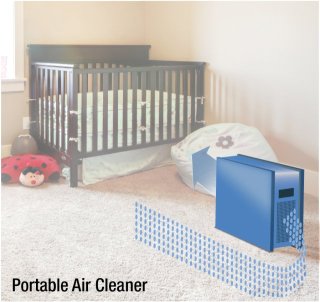
A portable air cleaner in a nursery in a home with dots and an arrow representing the flow of air through the device.

HEPA is a type of pleated mechanical air filter that is common in portable air cleaners, also known as air purifiers. It is an acronym for "high efficiency particulate air" filter, as officially defined by the U.S. Department of Energy. This type of air filter can theoretically remove at least 99.97% of dust, pollen, mold, bacteria, and other airborne particles with a size of 0.3 microns (µm). The diameter specification of 0.3 microns corresponds to the worst case; the most penetrating particle size (MPPS). Particles that are larger or smaller are trapped with even higher efficiency. 

By contrast, Minimum Efficiency Reporting Values, or MERVs, report a filter's ability to capture larger particles between 0.3 and 10 microns. 

  • MERV is helpful in comparing the performance of different filters, particularly for furnace or central heating, ventilation, and air conditioning (HVAC) systems.
  • The higher the MERV rating, the better the filter is at trapping specific sizes of particles.
  • For more information on MERV ratings, see the "What is a MERV rating?" link below.

Review EPA’s Guide to Air Cleaners in the Home for more information, including tips on selecting a portable air cleaner, furnace filter, or HVAC filter.

Related Questions

  • What is a MERV rating?
  • Will air cleaners reduce health risks?
  • What are ionizers and other ozone generating air cleaners?
  • Does EPA certify/register or provide lists of acceptable air cleaners or manufacturers/sellers?

Indoor Air Quality (IAQ)

  • Learn about Indoor Air Quality
  • IAQ by Building Type
  • Indoor Air Pollutants and Sources
  • IAQ Science and Technologies
  • Networking and Funding
  • Webinars, Meetings and Resources
  • IAQ Trending Topics
  • IAQ Frequently Asked Questions
  • Publications about IAQ
  • Regional and State IAQ Information
Contact Us about Indoor Air Quality
Contact Us about Indoor Air Quality to ask a question, provide feedback, or report a problem.
Last updated on January 13, 2026
  • Assistance
  • Spanish
  • Arabic
  • Chinese (simplified)
  • Chinese (traditional)
  • French
  • Haitian Creole
  • Korean
  • Portuguese
  • Russian
  • Tagalog
  • Vietnamese
United States Environmental Protection Agency

Discover.

  • Accessibility Statement
  • Budget & Performance
  • Contracting
  • EPA www Web Snapshot
  • Grants
  • No FEAR Act Data
  • Plain Writing
  • Privacy and Security Notice

Connect.

  • Data
  • Inspector General
  • Jobs
  • Newsroom
  • Regulations.gov
  • Subscribe
  • USA.gov
  • White House

Ask.

  • Contact EPA
  • EPA Disclaimers
  • Hotlines
  • FOIA Requests
  • Frequent Questions
  • Site Feedback

Follow.