


Black River AOC


Julie Carter
(GLRI-AOC-Program@epa.gov)
News
Final Impairment Removed as Black River Moves Closer to Delisting
Overview
Located west of Cleveland in Northern Ohio, the Black River watershed drains into Lake Erie near the City of Lorain. The Black River was once nicknamed the “river of fish tumors” due to its long history of industrial, agricultural, and urban uses, which led to poor water quality, loss of biodiversity, habitat degradation, and sedimentation. Environmental impacts became severe enough for the river to be designated as an Area of Concern (AOC) in 1987.
Historically, the City of Lorain relied on the river for bringing materials to and from its once prosperous industrial center. The river was used as a mode of commerce and was degraded by discharges from industrial operations and wastewater, which contributed to heavy metal and polynuclear aromatic hydrocarbon (PAH) contamination. Other events that played a role in the river’s impairments include:
- Municipal discharges
- Bank erosion
- Commercial and residential development
- Atmospheric deposition of contaminants
- Hazardous waste disposal sites
- Urban stormwater runoff and combined sewer overflows
- Agricultural runoff from the upper watershed
The river provides high-quality aquatic habitat suitable for state-listed endangered, threatened or state-designated “special concern” aquatic animal and plant species.
Beneficial Use Impairments
Beneficial Use Impairments (BUIs) are designations used by the International Joint Commission (IJC) that signify severe environmental degradation in AOCs. Removing BUIs indicates cleanup and restoration progress are being made in an AOC. There are 14 possible BUIs that an AOC can have designated, and once cleanup work is complete and monitoring has demonstrated sufficient environmental health improvements, BUIs are gradually removed. Originally, the Remedial Action Plan for the Black River AOC identified nine BUIs. As of June 2026, all BUIs are removed and the AOC can begin the formal delisting process.
- Restrictions on Fish and Wildlife Consumption (pdf) (2.1 MB) – Removed October 2016
- Fish Tumors or Other Deformities (pdf) (1.7 MB) - Removed October 2023
- Degradation of Fish and Wildlife Populations (pdf) (2.8 MB) – Removed August 2025
- Degradation of Benthos (pdf) (2MB) – Removed June 2026
- Restrictions on Dredging Activities (pdf) (1.6 MB) – Removed April 2022
- Eutrophication or Undesirable Algae (pdf) (2.1 MB) - Removed October 2016
- Beach Closings (pdf) (1.7 MB) - Removed July 2024
- Degradation of Aesthetics (pdf) (1.1 MB) - Removed January 2021
- Loss of Fish and Wildlife Habitat (pdf) (2.85 MB) - Removed August 2025
Remediation and Restoration Work
As of May 2024, all on-the-ground projects, or Management Actions, have been completed at the Black River AOC.
Under a consent decree from U.S. EPA, U.S. Steel dredged 50,000 cubic yards of PAH-contaminated sediment near the company’s coking complex from 1989 to 1990. Since then, EPA and partners have worked to restore the AOC by identifying six habitat restoration management actions. These projects have helped improve plant and animal populations, remove BUIs, and contribute to the eventual delisting of the AOC. As the AOC becomes closer to delisting, the City of Lorain and the surrounding area continue to see the ecological benefits of a healthier environment and the economic benefits that come from an accessible, healthy waterfront. Because of these efforts, those who live in the area may see an improved overall quality of life tied to restored local natural resources.
-
Reclamation Site Restoration

Additional Information describing Reclamation Site Restoration project.
-
Table of Projects
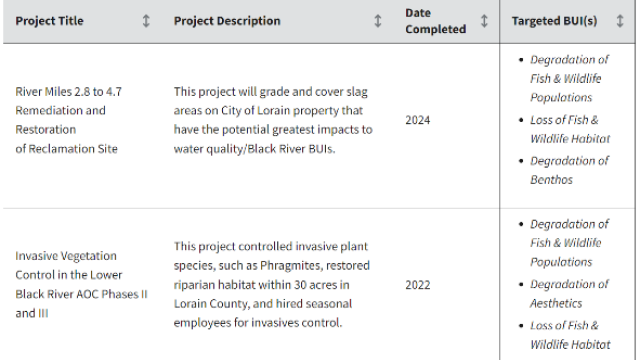
Learn more about restoration projects.