U.S. flag

An official website of the United States government

Here’s how you know

Dot gov

Official websites use .gov
A .gov website belongs to an official government organization in the United States.

HTTPS

Secure .gov websites use HTTPS
A lock (LockA locked padlock) or https:// means you’ve safely connected to the .gov website. Share sensitive information only on official, secure websites.

    • Environmental Topics
    • Air
    • Bed Bugs
    • Chemicals, Toxics, and Pesticide
    • Emergency Response
    • Environmental Information by Location
    • Health
    • Land, Waste, and Cleanup
    • Lead
    • Mold
    • Radon
    • Research
    • Science Topics
    • Water Topics
    • A-Z Topic Index
    • Laws & Regulations
    • By Business Sector
    • By Topic
    • Compliance
    • Enforcement
    • Guidance
    • Laws and Executive Orders
    • Regulations
    • Report a Violation
    • Environmental Violations
    • Fraud, Waste or Abuse
    • About EPA
    • Our Mission and What We Do
    • Headquarters Offices
    • Regional Offices
    • Labs and Research Centers
    • Planning, Budget, and Results
    • Organization Chart
    • EPA History

Breadcrumb

  1. Home
  2. Office of Inspector General

Fraud Alert: Notice of Violation Letter Phishing Scam

The U.S. Environmental Protection Agency Office of Inspector General is issuing this fraud alert to highlight an increasingly common phishing scam involving fraudulent EPA Notice of Violation letters. In this scam, a fraudster sends a falsified EPA Notice of Violation letter to a target business and requests that the business respond by phone or email.
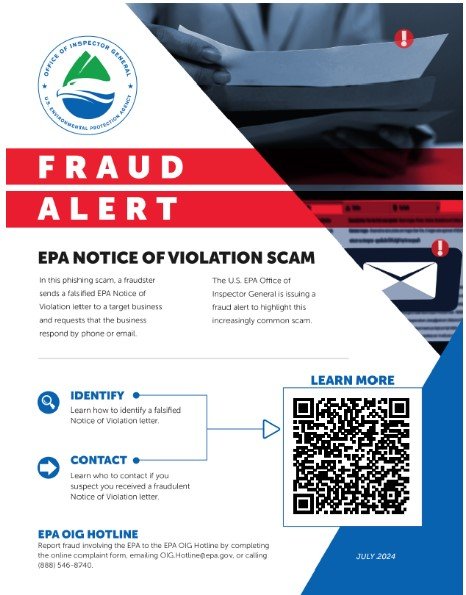
Fraud Alert: Notice of Violation Letter Phishing Scam

In recent instances of this crime, a fraudster sent falsified letters through email or U.S. Postal Service mail. The letters allege that the target business violated an environmental regulation such as the Clean Air Act. They indicate that the business owes thousands of dollars in fines and should respond by phone or email. However, the contact information provided—invoice@epa.services—is NOT associated with the EPA. Official U.S. government organizations use the “.gov” domain name; for example, “epa.gov.”

If you receive a Notice of Violation letter and are unsure of its validity, we encourage you to thoroughly review the letter, including the email address, and contact the EPA's enforcement office directly to verify authenticity. 

If you believe you have been the victim of fraud, or have knowledge of potential waste, fraud, or abuse involving EPA operations and programs, report it to the EPA OIG Hotline by completing the online complaint form, emailing OIG.Hotline@epa.gov, or calling (888) 546-8740.The U.S. Environmental Protection Agency Office of Inspector General is issuing this fraud alert to highlight an increasingly common phishing scam involving fraudulent EPA Notice of Violation letters. In this scam, a fraudster sends a falsified EPA Notice of Violation letter to a target business and requests that the business respond by phone or email.

Fraud Alert: Notice of Violation Letter Phishing Scam (pdf) (243.77 KB)

Office of Inspector General

  • EPA OIG Hotline
Contact the Office of Inspector General
Contact the Office of Inspector General to ask a question, provide feedback, or report a problem.
Last updated on December 3, 2025
  • Assistance
  • Spanish
  • Arabic
  • Chinese (simplified)
  • Chinese (traditional)
  • French
  • Haitian Creole
  • Korean
  • Portuguese
  • Russian
  • Tagalog
  • Vietnamese
United States Environmental Protection Agency

Discover.

  • Accessibility Statement
  • Budget & Performance
  • Contracting
  • EPA www Web Snapshot
  • Grants
  • No FEAR Act Data
  • Plain Writing
  • Privacy and Security Notice

Connect.

  • Data
  • Inspector General
  • Jobs
  • Newsroom
  • Regulations.gov
  • Subscribe
  • USA.gov
  • White House

Ask.

  • Contact EPA
  • EPA Disclaimers
  • Hotlines
  • FOIA Requests
  • Frequent Questions
  • Site Feedback

Follow.