


About Region 8's Laboratory Services
The Region 8 Laboratory Services Branch, housed within the Laboratory Services and Applied Sciences Division (LSASD), serves as a centralized hub for Region 8’s analytical and field support activities. Our laboratory analysts use state-of-the-art instruments, advanced analytical techniques, and rigorous quality assurance practices to ensure accurate, reliable data. In addition to analytical services, the laboratory provides technical guidance and project planning support for a wide range of partners and stakeholders, including agency regulatory and enforcement programs, Tribes, states, and local governments.
An overview of laboratory capabilities includes:
Send laboratory inquiries to:
The Region 8 Laboratory
R8Lab@epa.gov, orLaboratory Director
Tiago Seabra De Oliveira
SeabraDeOliveira.Tiago@epa.gov
Field Sampling and Training
The Region 8 Laboratory maintains an active field unit that provides field support for many project types, including assessment of streams, lakes, and groundwater, and personnel are instrumental in the National Lake and Stream Assessments. The field team offers:

- Field sampling: Staff are familiar with various methods of sample collection, preservation, and documentation. Field operations include:
- Stream flow: Flow measures are conducted using several methods to accommodate different hydrologic conditions.
- Field parameters: Advanced monitoring probes and methods accurately measure pH, dissolved oxygen, conductivity, turbidity, oxidation-reduction potential (ORP), chlorophyll, and other indicators.
- Vertical buoy system: Automated water quality vertical profiling capabilities offer robust limnologic assessment.
- Biology: Phytoplankton, zooplankton, benthic macroinvertebrate and fish sampling provides an indication of water quality and community composition.
- Training: Stream flow/hydrology and water quality programs are available to teach relevant skills and program design.
Water Quality Parameters
The laboratory provides analysis for a range of water quality parameters:
- Nutrients: Key parameters in determining ecosystem health, excessive nutrients can lead to eutrophication, oxygen-depletion, and harmful algal blooms (HABs). The Region 8 Laboratory differentiates:
- Nitrogen: Total nitrogen, ammonia, nitrate, nitrite
- Phosphorus: Total phosphorus, ortho-phosphate
- pH, alkalinity and hardness: Alkalinity represents a solution’s resistance to pH change (i.e., “buffering capacity”) while hardness measures the sum of calcium and magnesium. These parameters impact metal toxicity and aquatic organism health.
- Total and dissolved organic carbon (TOC and DOC): Carbon content of a waterbody influences metal toxicity, signals organic contamination, and serves as an indicator of ecosystem function.
- Anions: Chloride (Cl-), fluoride (F-), sulfate (SO42-), and other ions impact environmental health and denote anthropogenic impacts to aquatic ecosystems.
- Microbial: Capabilities exist for heterotroph, total coliform, fecal coliform, E. coli, and enterococci analysis in drinking water, wastewater, surface water, and groundwater.
Metals

Metal contamination from mining operations, mine tail pilings, and industry persists across the region. The Region 8 Laboratory provides analysis for over 30 different metals, ranging from aluminum to zinc. Capabilities exist for determining total and dissolved concentrations in different matrices.
Topical interest in the Region 8 Laboratory focuses on mercury analysis and metal speciation. Mercury is a toxic pollutant that bioaccumulates in fish and wildlife, which presents a human health risk to those consuming fish. Metal speciation, identifying and quantifying the specific chemical forms of a metal, influences metal toxicity, environmental mobility, and bioavailability.
Organic Pollutants

The Region 8 Laboratory has a state-of-the-art facility for the analysis of many organic compounds. The facility offers extensive sample preparation capabilities that can extract organic compounds from various matrices (e.g., water, wastewater, soil, sediment, and plant and animal tissue). Laboratory capabilities cover a wide range of organic compounds, including:
- Pesticides: Herbicides, insecticides, nematicides, and fungicides are ubiquitous in the environment and present a range of human and ecological health risks. The Region 8 Laboratory can analyze DDT, atrazine, glyphosate, and many other pesticides of concern.
- PFAS (per- and polyfluoroalkyl substances): Given the moniker “forever chemicals”, these compounds persist in the environment and exposure can lead to numerous human health effects. PFAS contamination is a priority issue for the EPA, and the Region 8 Laboratory meets quality analytical requirements.
- Volatile organic compounds (VOCs) and semi-volatile organic compounds (SVOCs): This diverse chemical group includes polycyclic aromatic hydrocarbons (PAHs), phthalates, phenols, and many other compounds. Analytical suites are also conducted, such as BTEX (benzene, toluene, ethylbenzene, xylene), GRO (gasoline range organics) and DRO (diesel range organics), which are often used to investigate leaking underground storage tanks and fuel spills.
- Pharmaceutical and personal care products (PPCPs): This generalized class of disparate chemicals, including prescription drugs, over-the-counter-medicines, hygiene products and illicit drugs, are increasingly found in our waters and receive expanding public attention.
- Other chemicals of concern: If there is a compound in which you are interested and don’t see here, please ask. Methods are constantly evolving to meet stakeholder analytical requirements.
Harmful Algal Blooms (HABs)
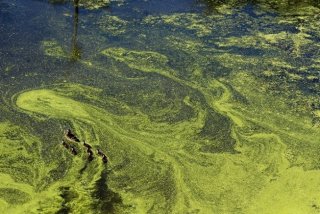
Also known as cyanobacteria, the Region 8 Laboratory performs several HAB-related analyses related to species composition and the toxins they produce. Projects include routine monitoring for state-wide assessments, response analysis for active blooms, and research in areas such as urban lakes and benthic blooms. Regional support includes:
- Species/community identification: Traditional microscopes provide informal identification, and an advanced FlowCam system for rapid community analysis differentiates between specific cyanobacteria, green algae, diatoms, and detritus.
- Cyanotoxin quantification: Either free (extra-cellular) or total (intra- and extra-cellular) forms of toxins originating from HABs can be determined.
- ELISA: Enzyme-Linked ImmunoSorbent Assay procedures measure microcystin, anatoxin-a, cylindrospermopsin, and saxitoxin.
- LC/MS/MS: Provides more specific toxin identification (e.g., dihydroanatoxin-a) for more detailed health assessments.
- HAB field sampling support:
- Staff provide on-site sampling assistance to partner entities.
- The laboratory delivers test kits to states, Tribes, and other federal agencies, which can be returned for analysis.
Safe Drinking Water Act (SDWA) Laboratory Certification
Region 8’s SDWA Laboratory Certification Program is housed in the Laboratory Services and Applied Science Division (LSASD) and managed through the Region 8 Laboratory. Region 8 Laboratory personnel trained as laboratory certification officers conduct on-site evaluations of laboratories operated by states and Tribes in the Region and audit the state certification programs to ensure that all laboratories analyzing drinking water samples are following approved methods as mandated by EPA's National Primary Drinking Water Regulations. This ensures the public that their drinking water is free from harmful contaminants. Region 8’s Laboratory Certification Program is unique in that it has direct implementation responsibility for drinking water laboratories in Wyoming. Additionally, the laboratory can assist Tribes in developing laboratories and to conduct audits.
Information for Wyoming and Tribal Drinking Water Programs in EPA Region 8