


Caney Residential Yards National Priorities List (NPL) Superfund Site, Caney, Montgomery County, Kansas – Fact Sheet, Nov. 2025
Residential Yard Testing and Cleanup Opportunity
Why Is EPA Cleaning Up Yards in Caney?

To protect human health and the environment, the U.S. Environmental Protection Agency (EPA) Region 7 (R7) is cleaning up hazardous wastes found in residential yards and child high-use areas in Caney. Lead contamination was found throughout the city from historic lead and zinc smelting activities in the area. Smelter waste and emissions contaminated city properties. Lead is a toxic metal that is harmful if inhaled or swallowed. Lead is classified by EPA as a probable human carcinogen and is a cumulative toxicant that affects multiple body systems. Lead is the main contaminant of concern at this site. Learn more about lead on Page 2. The Caney site was added to EPA’s National Priorities List (NPL) in 2020. The NPL includes hazardous waste sites in the U.S. that are eligible for long-term remedial cleanup under the EPA Superfund program.
To protect the community from lead poisoning, EPA is conducting a remedial action at the Caney Residential Yards Superfund Site (site). EPA is remediating — also called cleaning up — lead contamination at residential properties and/or other child high-use areas (such as parks, playgrounds and childcares) that meet or exceed EPA’s cleanup level of 200 parts per million (ppm) of lead in soil. To do so, EPA excavates contaminated soils and disposes of them at a designated off-site disposal site. Next, EPA replaces the yard with clean soil and restores the lawn. However, EPA needs permission from property owners to test and/or clean up yards. See below for EPA contacts.
Remedial Action Update
So far, 1,041 Caney residents have signed up for EPA’s lead testing program, and testing (sampling) has been conducted accordingly. Additionally, over 400 Caney residents have granted EPA access to remediate lead-contaminated areas of their yards.
Under this current remedial action, residential soil lead testing and remediation/cleanup are performed at no cost to the property owner.
How Can I Sign up for Yard Testing? |
|---|
Contact EPA or our contactors today! If EPA has not tested your yard (or child high-use area) for potential lead contamination yet, please contact EPA or EPA’s contractor, Leisnoi-Kemron - phone: 561-777-3233; email: Jkettle@leisnoi.com. You can also contact EPA R7 directly by phone at 816-398-1902 or toll-free at 1-800-223-0425; email: r7-tsmd@epa.gov. EPA can only test for contamination once the property owner or tenant gives permission by signing a permission form. See the form at: https://semspub.epa.gov/work/07/30826810.pdf. |

By allowing EPA access to your yard, a contractor can collect soil samples at a time most convenient to you.
These samples are then sent to a certified lab for analysis, and EPA will mail you a detailed report of the testing results. Learn more at https://semspub.epa.gov/work/07/30826308.pdf.
How Can I Participate in the Cleanup?
If EPA tests your yard and finds soil lead levels above 200 ppm, and your property is eligible for cleanup, you will receive a sampling results letter along with a permission form requesting your permission for EPA to remediate the contaminated areas. Once you sign and return the form via scan, email, or mail, EPA can arrange a time to conduct the cleanup with you. Learn more at https://semspub.epa.gov/work/07/30826307.pdf.
About Lead and Public Health
Lead affects multiple body systems and is particularly harmful to children under 7 years old (as their brains and nervous systems are still developing), as well as pregnant women and nursing mothers. Lead is dangerous to children because their growing bodies absorb more lead than adults do, and their developing brains and nervous systems are more sensitive to the damaging effects of lead. Lead exposure can cause a range of adverse health effects, including behavioral disorders, learning disabilities, and seizures, putting young children at the greatest risk.
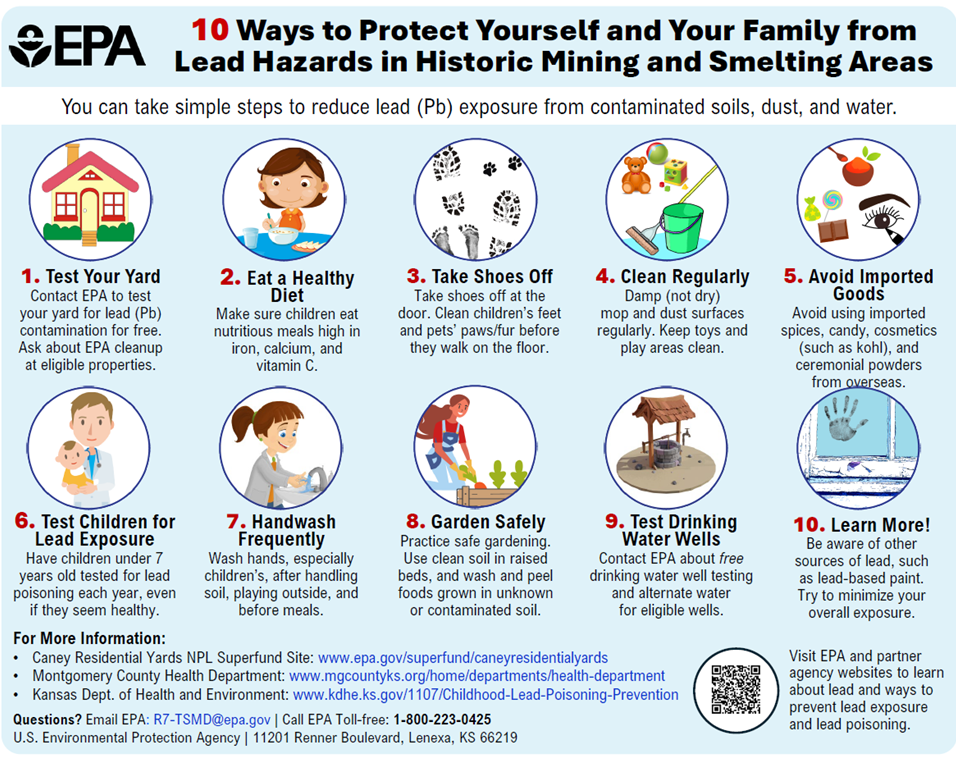
It is important to avoid exposure to lead hazards to prevent lead poisoning. To learn more about lead, visit:
- EPA's Lead page
- CDC's Childhood Lead Poisoning Prevention page
- EPA Region 7's Protect Your Family from Lead Hazards Fact Sheet
If you do not have internet access, you can visit a local public library, such as the Caney Public Library, 211 W. 5th Ave., Caney, KS 67333.
Annual Blood Lead Testing
Have children under 7 years old tested for lead exposure (a blood lead level test) annually. Children suffering from lead poisoning may not look or act sick. The only way to know if your child has elevated levels of lead in their blood is to have their blood tested. Talk to your pediatrician, general physician, or health department, such as:
Montgomery County Health Department
604 S. Union
Coffeyville, KS 67337
620‑251-4210
Additional Information
EPA encourages community members to participate in the residential lead testing and cleanup opportunity, ask questions, and share comments and any site concerns. For more information, site history, site-update fact sheets, site contacts, the Superfund process (at https://semspub.epa.gov/work/07/30829455.pdf), and ways to get involved, see Site Documents & Data at: www.epa.gov/superfund/caneyresidentialyards.
For more information, site history, and a previous Fact Sheet, visit EPA's Site Profile page (see Site Documents & Data).
Site Contact Information
EPA encourages community members to ask questions, share comments, and any site concerns.
- Whitney Bynum, U.S. EPA remedial project manager (Superfund/LMSE/MSRS) - phone: 816-398-1902; email: bynum.whitney@epa.gov.
- Brian Madeira, U.S. EPA remedial project manager (Superfund/LMSE/MSRS) - phone: 816-319-8940; email: madeira.brian@epa.gov.
- Hilary Elizabeth Kramer, U.S. EPA community involvement coordinator - phone: 816-589-5534; email: kramer.elizabeth@epa.gov.
- Matt Ferguson, PhD, Agency for Toxic Substances and Disease Registry, CDC, regional representative - phone: 913-416-2118; email: qcb9@cdc.gov.