


Promoting Cleaner Fuels and Vehicles Worldwide
The Partnership for Clean Fuels and Vehicles (PCFV) is a global public-private partnership working with developing and transitional countries to reduce air pollution from vehicles through the promotion of cleaner fuels and vehicles.
EPA was a charter member of the Partnership, which began its work in 2002 and now includes 73 partners. The partnership kicked off its international cooperation with a focus on the promotion of unleaded fuels. The PCFV helped achieve great success through the elimination of the use of leaded gasoline worldwide in 2021.
The phaseout of lead from gasoline globally has resulted in economic benefits from the prevention of lead exposure in children everywhere. [Reference: Peter L. Tsai and Thomas H. Hatfield. “Global Benefits from the Phaseout of Leaded Fuel.” Journal of Environmental Health. 74: 8-14. 2011.]
Beginning in 2008, the PCFV’s second focus area was to reduce sulfur in fuels. At that time, few developing countries had low sulfur fuel policies. Since 2009, the PCFV has helped more than 20 countries – whose populations total over 1.7 billion – implement low sulfur diesel fuel standards (50 ppm or below). This effort has significantly reduced sulfur dioxides and particulate matter, both of which have significant impacts on human health.
The PCFV also launched a third campaign – the vehicles campaign – recognizing that governments that have been successful in securing cleaner fuels would achieve greater environmental and health impacts by combining cleaner fuels with cleaner vehicles that take advantage of innovative emission control technologies.
The PCFV engages governments and stakeholders in developing countries:
- To eliminate lead in gasoline globally. This goal was successfully accomplished in July 2021. View more details about the campaign to remove lead from fuels.
- To promote access to fuel no more than 50 ppm sulfur. For comparison, the United States uses 15 ppm sulfur diesel fuel; some developing countries still offer fuels that are much higher in sulfur content. View regional and global updates on progress reducing sulfur content in fuels.
- To promote the introduction of cleaner, more efficient vehicles. Since 2012 six developing countries have adopted vehicle emission standards, and additional countries are using the PCFV Regulatory Toolkit to develop standards. View more details of the work to promote cleaner vehicle and emission technologies.
Evaluations, Tools and Outcomes from PCFV’s Work
Report on Addressing the Used Vehicles Market
The PCFV released a report in February, 2019 titled “Addressing the Used Vehicles Market: Potential Strategies for Importing and Exporting Countries to Improve Safety, Fuel Economy and Emissions Impacts.”
A large percentage of vehicle fleets in developing and transition countries are imported used or second-hand vehicles, and demand for vehicles in these countries has grown significantly. Imported vehicles can be much cleaner and efficient. The report outlines potential strategies to improve used vehicle fleets, which can have a wide range of benefits including reducing pollution.
PCFV Regulatory Toolkit
The Partnership for Clean Fuels and Vehicles (PCFV) has been working with developing and transitional countries to reduce vehicular air pollution through the promotion of cleaner fuels and vehicles. With support from EPA and Environment Canada, the PCFV created a regulatory toolkit to introduce the need for a systems approach to vehicle emission reduction. A systems approach matches fuels and vehicle improvements - to move towards tighter vehicle emissions regulations.
This toolkit supports developing and transitional countries to introduce requirements for 50 ppm and below sulfur fuels; produce or import lower emitting and more efficient vehicle technologies; establish vehicle emissions control roadmaps; and ultimately improve air quality and human health in these countries.
Tools for Decision-Makers – Clean Fleet Management Toolkit
Global Context for Promoting Cleaner Fuels and Vehicles Worldwide
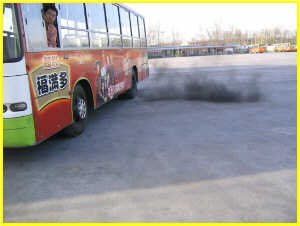
Today, transportation demand is growing rapidly in developing countries. This, combined with rising personal vehicle ownership, is causing significant impacts on urban air quality. For example, transport is potentially one of the biggest sources particulate matter pollution, especially in cities.
According to the World Health Organization (WHO), outdoor air pollution contributes annually to over 7 million premature deaths worldwide and it now ranks among the top global health risk burdens. In 2021, WHO released new global air quality guidelines and reported that 99% of the world’s population lives in places where the air quality levels exceed WHO limits.
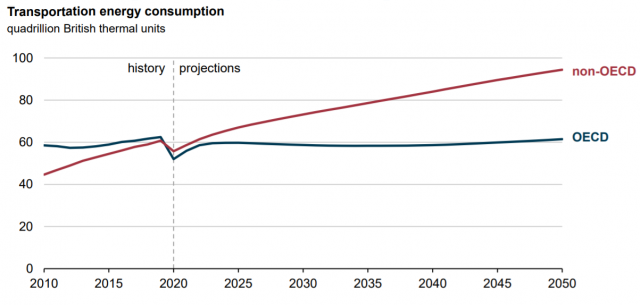
Globally, the US Energy Information Administration (EIA) predicts in its International Energy Outlook 2021 (PDF) (85 pp, 1.5 M, About PDF) that refined petroleum and other liquid fuels will remain the dominant source of energy for the transportation sector through 2050. The EIA report predicts that energy demand in the transport sector will grow in developing countries (defined here as countries that are not a part of the Organization for Economic Cooperation and Development [OECD]), as the chart (right) displays, but remain largely the same for OECD countries.
Promoting Cleaner Fuels in Indonesia
From 2010-2016, EPA worked with Indonesia to develop cost-benefit analyses to promote government fiscal policies, to create and foster dialogue amongst a cross-government and industry stakeholders group, and to engage the government-owned petroleum company Pertamina. As a result of this work, Indonesia plans to introduce low sulfur fuels that meet the PCFV target of 50 ppm.
PCFV Evaluation by EPA (December 2011)
Findings
PCFV Lead Campaign Startup and Design
Lead Campaign Implementation
PCFV Evaluation by UNEP (October 2010)
- Without the PCFV it would have taken at least 10 years rather than five to phase out lead in SSA (conservative estimate).
- The PCFV therefore contributed to health benefits, which in turn promoted social and economic gains.
- UNEP operated as a high level advocate to governments, as a channel to resources within the Partnership, and as a facilitator and supporter of activities at various levels.