


Wildfire Study to Advance Science Partnerships for Indoor Reductions of Smoke Exposures
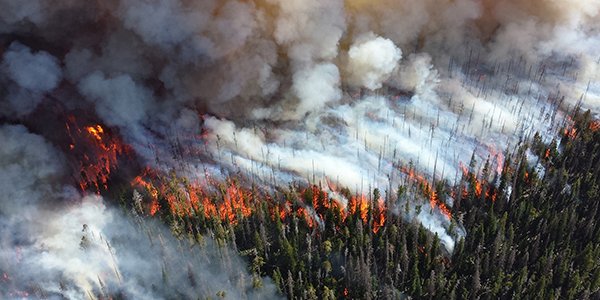
Many communities may be exposed to smoke from wildland fires, including wildfires and prescribed or controlled burns, for days, weeks, or even months each year. This smoke exposure can lead to increased health risks. To reduce exposure, a common recommendation is to stay indoors away from the smoke and close all doors and windows.
While closing doors and windows does reduce exposure, smoke can still infiltrate indoors, emphasizing the importance of creating cleaner air spaces that effectively reduce smoke exposures.
To fill knowledge gaps about public buildings or facilities where people congregate during smoke episodes, EPA researchers worked with community and Tribal partners in Montana and California to study how air cleaning and ventilation practices impact indoor air quality during wildfires. In addition, EPA researchers and their partners were interested in more information about technologies people can use to provide cleaner air spaces in their homes.
Information on current particulate matter air quality, fire locations and smoke plumes, smoke forecast outlooks, and recommendations for actions to take before, during, and after a wildfire are available on AirNow's Wildfire webpage.
Additional resources are available on EPA's Smoke-Ready Toolbox for Wildfires.
Study Objectives
EPA researchers partnered in a study with Missoula Public Health (MPH) in Montana, the University of Montana, the Hoopa Valley Tribe in California, and other communities to measure air pollutants under typical conditions and when smoke episodes were anticipated. The objectives of the research—called the Wildfire Advancing Science Partnerships for Indoor Reductions of Smoke Exposures (ASPIRE) Study—were to compare indoor and outdoor fine particulate matter (PM2.5) concentrations and develop strategies for reducing indoor pollutants in public buildings during wildland fire smoke events. PM2.5 is the pollutant that is a primary health threat from smoke exposures.
Additional components of the project included laboratory evaluations or performance of air cleaning technology under wildfire smoke conditions, a prize-based challenge to encourage innovative ideas for air cleaning approaches in homes, and a study to assess the use of air cleaners in homes to improve indoor air quality and health outcomes during smoke events. The research activities are described below.
The project was part of an initiative that emphasized working directly with stakeholders to develop solutions to public health and environmental concerns. The research involved local partners from the beginning to identify what information they needed to effectively communicate actions that building owners and the public can take to reduce public health risks during smoke episodes.
The research findings can be used by air quality managers, public health professionals and community members to reduce health risks from smoke exposure and expand understanding of the impact of building characteristics and ventilation systems on indoor air quality during smoke episodes. This project was designed to serve as a model for future community-based research on how to engage partners throughout a research project.
The research questions for this study were:
- How effective are air filtration systems during smoke events?
- What are the concentrations of PM2.5 indoors and outdoors?
- How does filtration effectiveness vary by outdoor concentration and type of air handling system?
- How effective are portable air cleaners in reducing PM2.5 concentrations?
- What operation and maintenance factors are important in air cleaner effectiveness?
- What innovative approaches can help reduce wildfire smoke exposures?
Monitoring Approach
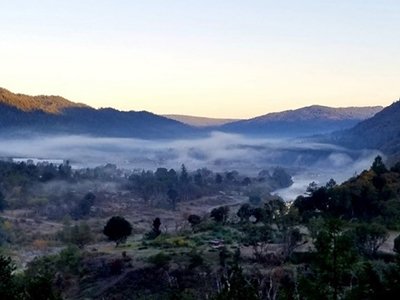
In 2019, researchers began conducting field monitoring of PM2.5 concentrations inside and outside of commercial and public buildings in Missoula and Hoopa to understand real-world variation under typical ambient conditions and when smoke events occur. Researchers selected an air sensor that relies on an optical detection method and collects a data point every two minutes. They co-located the sensors with regulatory grade reference monitors prior to deployment to evaluate their accuracy and developed a correction equation to reduce any bias in the sensor data.
In addition to stationary monitoring, researchers used a portable, mobile monitoring system they developed to map outdoor smoke concentrations and observe how concentrations vary when smoke funnels into mountain valleys and surrounding areas. The monitoring system, Vehicle Add-on Mobile Monitoring System (VAMMS), is the size of a small brief case and can be mounted to a vehicle to take mobile measurements in a designated area.
EPA has built additional VAMMS to lend to Air Resource Advisors with the Interagency Wildland Fire Air Quality Response Program as part of the Wildfire Smoke Air Monitoring Response Technologies (WSMART) Loan Program. The monitoring equipment is used in areas experiencing wildfires to provide more air quality monitoring capabilities.
Learn more about the WSMART Loan Program.
The research team shared findings from the field studies in Missoula and Hoopa with the local and Tribal partners and published results in peer-reviewed literature.
Study Location: Missoula, Montana
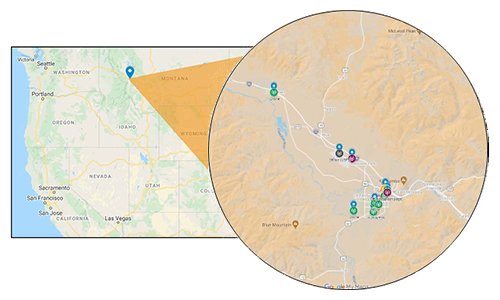
Missoula was selected as a study location due to an extreme smoke season in 2017 and the local health department’s enthusiasm and dedication to improve understanding of clean air spaces within their community. EPA partnered with the Missoula Public Health (MPH), the University of Montana, the U.S. Forest Service Fire Sciences Laboratory, and Climate Smart Missoula to design and implement the field study.
Missoula partners and EPA researchers focused on public and commercial buildings used by larger numbers of people during fire season such as fitness centers, museums, senior centers, and office spaces. MPH worked with property owners to obtain site permission, plan specific locations inside and outside for air measurement equipment placement, and identify points of contact who would be available throughout the summer to coordinate and collect monitoring data.
The Missoula field study included measuring air quality during two wildfire seasons. The first wildfire season in 2019 involved collecting measurements at 18 buildings from late July to early September. During this period, there were two prescribed fire smoke events in August.
A second season of measurements began in June 2020 and included 17 buildings. Adjustments were made to the field study approach, building on lessons learned from the previous year’s study, which included converting the sensors to online data reporting, expanding sampling to two nearby towns to potentially capture more smoke events, extending the timeframe of measurements into the fall to potentially capture more smoke events, and increasing the diversity of buildings monitored. Buildings characteristics and air ventilation systems in each study location were evaluated to better understand how buildings or occupants affect indoor air pollutant concentrations. During the 2020 study period, a week of sustained high PM2.5 concentrations related to wildfire smoke was observed in mid-September.
Monitoring and data analysis for the Missoula study were completed and the findings published in peer-reviewed literature:
Study Location: Hoopa Valley Tribe, California
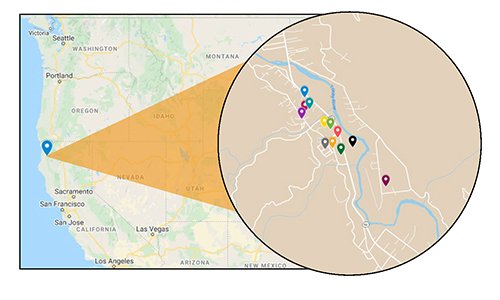
Hoopa was selected as a study location due to the risk of wildfire smoke impacts extending from summer into late fall, and wood smoke impacts and frequent atmospheric inversions during winter, which traps air pollution close to the ground. If the air is stagnant for too long, air pollution will accumulate. EPA researchers chose to partner with the Hoopa Valley Tribe and the Tribal Environmental Protection Agency (TEPA) after the Tribe expressed an interest in participating in the project to learn more about indoor air quality and creating cleaner air spaces in their community.
At the Hoopa Valley Tribal Reservation, air sampling was conducted on a continual basis between December 2019 and March 2022 at 13 buildings to capture wildfire smoke episodes and other causes of heightened PM2.5 concentrations, such as emissions from woodstoves and outdoor burning as well as atmospheric inversions. The field study included fewer sampling sites than Missoula given the overall smaller geographic area and population size in Hoopa Valley. Researchers observed extremely high PM2.5 concentrations in Hoopa in October 2020 related to the Red Salmon Complex Fire.
Air quality monitoring in Hoopa has concluded and EPA researchers reported results back to the community.
Laboratory Study on Air Cleaning Technology
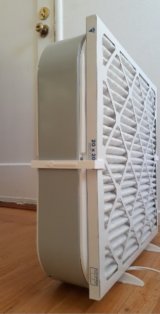
with an air filter clamped onto a box fan.
A complementary, laboratory-based study was carried out in Research Triangle Park, North Carolina, to learn more about how effective air cleaning technology is for reducing smoke indoors under simulated real-world conditions. Researchers evaluated portable air cleaners, ranging from a Do-It-Yourself (DIY) air cleaner (composed of a box fan with an attached furnace filter) to commercial air cleaners. EPA partnered with Chemical Insights Research Institute of Underwriters Laboratories Inc. (UL) to conduct safety evaluations prior to testing the air cleaners under simulated smoke conditions. Learn more about the UL safety testing below.
The air cleaners were evaluated for their effectiveness at removing PM2.5 and other toxic pollutants, as well as their ease of use and cost to operate. These experiments helped researchers understand the range of effectiveness that may be achieved using these air cleaner technologies to reduce smoke exposure and best practices for their use.
- Research on DIY Air Cleaners to Reduce Wildfire Smoke Indoors
- Impact of Do-It-Yourself Air Cleaner Design on the Reduction of Simulated Wildfire Smoke in a Controlled Chamber Environment, Holder et. al, 2022, Journal Article
Safety Testing DIY Air Cleaners
EPA researchers supported safety testing by the Chemical Insights Research Institute of Underwriters Laboratories Inc. (UL) to assess the fire and burn risks from DIY air cleaners. These air cleaners are commonly used to filter smoke particles during wildfires and are made by attaching an air filter to a box fan with tape or a bungee cord. Since commercial air cleaners can be difficult to obtain during wildfires due to supply or cost, many health and air quality agencies and nonprofits have begun providing instructions for making these DIY air cleaners. UL has released a report on the testing results, Wildfire Safety Research: An Evaluation of DIY Air Filtration.
ASPIRE-Health Studies
EPA researchers partnered with the Hoopa Valley Tribe to add a study component in 2021 called ASPIRE-Health. Researchers tested the effectiveness of DIY and commercial air cleaners in improving air quality and health during the wildfire season and during wintertime in residences that used woodstoves for heat.
Two manuscripts summarizing the Hoopa pilot studies have been published:
- Self-reported health impacts of do-it-yourself air cleaner use in a smoke-impacted community
- Usage and impact of a do-it-yourself air cleaner on residential PM2.5 in a smoke-impacted community
The lessons learned from these pilot studies informed a similar EPA field study in a larger number of homes in Tulare County, California in 2023. The goal of this study was to evaluate the impact of wildfire smoke on indoor air quality and health measures under one of three scenarios: (1) Baseline conditions at the home (no intervention), (2) Running a low-cost do-it-yourself (DIY) air cleaner in the home, and (3) Running a commercial air cleaner in the home. Researchers also assessed participants’ use and perceptions of the DIY and commercial air cleaners. Home reports detailing preliminary findings were provided to participating households at the end of October 2024.
Prize-based Challenge
The Cleaner Indoor Air During Wildfires Challenge Competition was sponsored by EPA in partnership with 10 federal, state, local, and Tribal organizations. The goal of this challenge was to encourage development of new, effective, low-cost approaches (termed “solutions”) to remove PM2.5 from indoor air, particularly high concentrations related to smoke events or other high pollution episodes.
EPA and its partners offered the Challenge in two phases.
- Phase 1, launched in 2021, was a theoretical, or design challenge requiring an in-depth written proposal but not requiring development of a prototype. Five Phase 1 winners and three honorable mentions were selected for awards.
- Phase 2, launched in 2022, encouraged the Phase 1 winners and honorable mentions to develop and submit a prototype of their proposed air cleaning technology. EPA scientists then tested these prototypes to determine the winners. Two submissions were selected for awards.
- Winners of the Cleaner Indoor Air During Wildfires Challenge
Commercial and School Building Guidance Collaboration
EPA researchers and other federal and international organizations served on a committee organized by ASHRAE (formerly the American Society of Heating, Refrigerating and Air Conditioning Engineers) to develop guidelines for commercial buildings, including schools, to reduce smoke exposure for occupants. The guideline, ASHRAE Guideline 44-2024, Protecting Building Occupants from Smoke During Wildfire and Prescribed Burn Events, was released in December of 2024. To meet the immediate need for information on protecting building occupants prior to the report's release, EPA researchers and other committee members developed an interim planning framework that highlights steps to develop a building-specific smoke readiness plan by evaluating and preparing heating, ventilation, and air conditioning (HVAC) systems to filter smoke and other building measures to minimize smoke intrusion during wildfires and prescribed burning. The interim guidance document is entitled Planning Framework for Protecting Commercial Building Occupants from Smoke During Wildfire Events.
- Interim Guidance Planning Framework for Protecting Commercial Building Occupants from Smoke During Wildfire Events
- ASHRAE Guideline 44-2024, Protecting Building Occupants from Smoke During Wildfire and Prescribed Burn Events
EPA researchers also developed a report to support building owners or decision makers without HVAC expertise. It provides recommendations and resources to reduce indoor exposure to elevated particulate matter (PM) and gaseous pollutant concentrations in public, commercial, and multi-unit residential buildings during wildland fire smoke events.
- Best Practices for Improving Indoor Air Quality in Commercial/Public Buildings During Wildland Fire Smoke Events
- Wildfires and Indoor Air Quality in Schools and Commercial Buildings
- Flyer: Recommendations for Reducing Wildfire Smoke in Commercial Buildings and Schools
Community Partners
- Hoopa Valley Tribe Land Management Department
- Missoula Public Health
- Central California Environmental Justice Network
- USFS Missoula Fire Lab
- Climate Smart Missoula
- United States Forest Service
Additional Links and Resources
Related Resources
- Science Matters: Multi-faceted EPA Research Addressing Threats to Public Health from Wildfire Smoke
- Science Matters: In the Field with EPA: Monitoring the Impact of Wildfires and Woodsmoke on Indoor Air Quality
Presentations
- Wildfire Advancing Science Partnerships for Indoor Reductions of Smoke Exposures (ASPIRE) Study – EPA Tools & Resources webinar, May 21, 2025
- Preparing for Wildland Fire Smoke – EPA Tools & Resources webinar, May 18, 2022
- Safety and Efficacy of DIY Air Cleaners for Wildfire Smoke Reduction – Federal Interagency Committee on Indoor Air Quality Presentation, February 14, 2023
- How to Evaluate Air Sensors for Smoke Monitoring – EPA Tools & Resources webinar, February 16, 2022
- Using a Particle Sensor Network to Characterize Air Quality of Buildings in Areas Prone to Wildfires – Air Sensors International Conference (ASIC), October 22, 2020
- Using a Particle Sensor Network to Characterize Indoor and Outdoor Air Quality of Buildings in Areas Prone to Wildfires - Third International Smoke Symposium (ISS3) Presentation – April 20-24, 2020
- PM2.5 Measurements Inside and Outside of Buildings in Missoula, MT During Summer 2019 - Presentation of field study summary
- Clean Air Spaces - Indoor Air Filtration to Protect Public Health During Wildland Fire Smoke Episodes - June 2019 web summit