


Battery Collection Tip Sheet: Safely Collecting and Managing E-Cigarettes from Households
On this page:
- Intended Audience
- Introduction
- Determining How to Manage Waste E-Cigarettes Collected from Households
- Managing Nicotine E-Liquids and E-Cigarettes with Embedded Batteries Collected from Households
- Managing Lithium Batteries Removed from Waste E-Cigarettes
Intended Audience
The Safely Collecting and Managing E-Cigarettes from Households Tip Sheet is for businesses such as vape shops or other e-cigarette retailers that are interested in collecting unwanted nicotine e-cigarettes from individuals and households.
These businesses can help ensure that e-cigarette waste stays out of the municipal waste stream and is safely disposed of as hazardous waste. The following information will help businesses determine whether running an e-cigarette collection program is right for them, identify the regulations and logistics to consider before and while managing collected waste e-cigarettes and provide best-practice recommendations for safety and compliance.
If you are a school or small business that generates waste e-cigarettes through normal operations, refer to the U.S. Environmental Protection Agency's guidance for schools and small businesses on safely disposing of e-cigarettes.
Introduction
E-cigarette waste is a growing hazard
When e-cigarettes enter the municipal solid waste stream, they can pose significant risks to human health and the environment. These devices contain nicotine e-liquids and lithium batteries, both of which are hazardous. When nicotine is ingested or absorbed through the skin it is toxic to humans and deadly to animals. Lithium batteries can easily catch fire or explode and have caused fires at municipal solid waste facilities across the United States. When e-cigarettes are properly collected and managed at the end of their lives, these safety, health and environmental risks decrease. While local governments typically manage household hazardous waste collection, they may approve businesses, such as vape shops or other e-cigarette retailers, as alternative collection sites for e-cigarettes from the public.

E-cigarettes vary in design and form
E-cigarettes, also known as vapes, e-cigs or electronic nicotine delivery systems, come in a range of designs. They all contain a lithium battery and are designed to vaporize nicotine e-liquid or other e-liquids contained in a reservoir. Most e-cigarettes on the market are single use and are not reusable or refillable. However, some have a replaceable nicotine cartridge or may be refillable with nicotine e-liquid.
Federal, state and municipal regulations may shape e-cigarette waste protocols
- Federal regulations consider waste e-cigarettes to be household hazardous waste when individuals generate them on the premises of temporary or permanent residences. The Resource Conservation and Recovery Act exempts household hazardous waste from being regulated as hazardous waste. While most states also exempt waste e-cigarettes that are collected from individuals and households from hazardous waste regulations, collected e-cigarettes still pose fire and toxicity risks. Therefore, the U.S. Environmental Protection Agency strongly recommends that consumers bring their waste e-cigarettes to household hazardous waste collection sites for safe disposal.
- Some e-cigarettes have batteries that are designed to be removed. If batteries can be easily removed from the e-cigarettes your business collects, manage the batteries as universal waste. The U.S. Environmental Protection Agency strongly encourages recycling batteries that have been removed from e-cigarettes with a battery recycler.
- If a business generates its own hazardous waste, the business must keep it separate from any e-cigarettes it collects from the public. The business must manage the hazardous waste it generates as required under the Resource Conservation and Recovery Act. If collected household waste e-cigarettes are mixed with the business's own hazardous waste, the waste will lose the household hazardous waste exemption.
- Each state and municipality may have different rules and regulations for household hazardous waste and e-cigarette collection and management. While this tip sheet serves as a resource for alternative household hazardous waste e-cigarette collection sites, check with your state, county, and local environmental, health, or solid waste agency for additional requirements.
- All other household hazardous waste collection sites should accumulate e-cigarettes in a manner that will prevent fires and the release of hazardous materials into the environment.
Check out the full tip sheet: Safely Collecting and Managing E-Cigarettes from Households (pdf) .
Determining How to Manage Waste E-Cigarettes Collected from Households
Before beginning collection of waste e-cigarettes
Businesses have two options for managing e-cigarettes that they collect from households:
- Option 1: Establish a collection agreement with a local household hazardous waste management facility, if available in your area. Determine pickup or drop-off protocols with the facility in advance of collection. Some household collection facilities may prefer to pick the waste up to ensure safe transport.
- Option 2: Contract with a hazardous waste transporter for post-collection pickup and transportation to a hazardous waste management facility.
If you are contracting with a hazardous waste transporter, identify sources of funding for recycling or disposal. For example, determine if the funding will come from your own business, grant funding or another business or sponsor.
Take all appropriate steps to safely store and manage battery and nicotine e-liquid waste and follow all state and local household hazardous waste requirements described in the below sections.
The decision tree shows a series of steps to help household hazardous waste e-cigarette alternative collection sites determine best practices for collecting e-cigarettes. Refer to the additional resources in this tip sheet for more detailed guidance on steps from pre-collection to disposal.
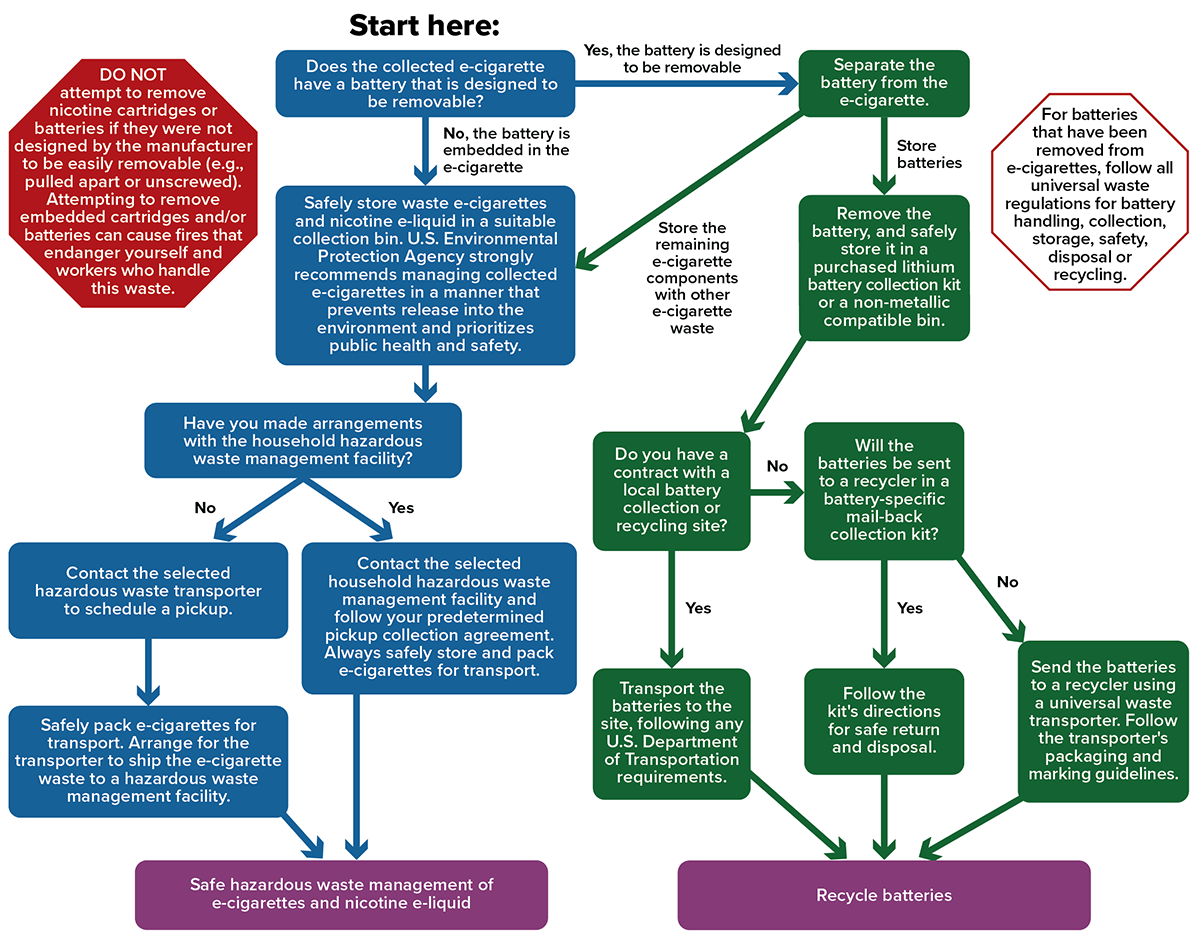
| E-Cigarette Household Hazardous Waste Collection Best Practices | |
|---|---|
What to do:
| What not to do:
|
Managing Nicotine E-Liquids and E-Cigarettes with Embedded Batteries Collected from Households
Reminder: before setting up a collection program, determine if the e-cigarettes collected from the public will be disposed of through an existing household hazardous waste management facility OR if your business will contract with a hazardous waste transporter. Refer to Determining How to Manage Collected E-Cigarettes from Households to begin. Always follow any applicable regulations.
Handling and Collection

IMPORTANT: DO NOT attempt to remove nicotine cartridges or batteries that are not designed to be easily removeable (e.g., pulled apart or unscrewed). Attempting to remove embedded cartridges and/or batteries can cause fires that endanger you and workers who handle this waste.
- Train workers to safely manage collected e-cigarettes and hazardous materials.
- Wear chemical-resistant gloves made from nitrile or latex when handling e-cigarettes and nicotine e-liquids.
- Ensure the e-cigarette is powered off before storing it, if it has a power button.
- Remove the nicotine cartridge only if the manufacturer designed it to be removed.
- Place each e-cigarette in an individual plastic bag.
- Place nicotine vials and cartridges in plastic bags. You can store multiple individual nicotine vials and cartridges in the same bag.
- Store plastic bags with e-cigarettes and nicotine e-liquids in a non-metallic container that is compatible with nicotine and battery waste.
Storage
- Keep the collection bin in a secure, locked location, away from the public.
- Label the exterior of the collection bin with the words "hazardous waste" and its contents (e.g., nicotine e-cigarettes, nicotine e-liquids).
- Open the collection bin only when adding more waste. Inspect the container for damage.
- Do not mix other household hazardous or business/organization waste with e-cigarettes or nicotine e-liquids.
- Store only nicotine e-cigarettes or vials of nicotine e-liquids in the collection bin.
- Store the collection bin in a climate-controlled space away from heat, cold, direct sunlight and water.
Safety
- Keep a smoke detection system, fire extinguisher and fire-suppressant materials near the collection bins.
- Develop a regular pickup schedule to avoid storing an excessive stockpile of e-cigarettes and nicotine e-liquid.
- Develop an emergency response procedure and maintain regular contact with the local fire department.
Disposal
- If you have made arrangements with a household hazardous waste facility, contact the facility to schedule a pickup or drop-off. Safely pack e-cigarette and nicotine e-liquid waste for transport.
- If using a hazardous waste transporter, contact the transporter to schedule a pickup. Safely pack e-cigarette and nicotine e-liquid waste for shipment. Arrange for the transporter to ship the e-cigarettes to a hazardous waste management facility.
- Safely dispose of e-cigarette and nicotine waste through proper hazardous waste management.
Additional Resources
- How to Safely Dispose of E-Cigarettes: Information for Individuals.
- How to Safely Dispose of E-Cigarettes: Information for Schools and Small Businesses.
- U.S. Environmental Protection Agency Incident Waste Decision Support Tool: Search by location for household hazardous waste collection sites.
Managing Lithium Batteries Removed from Waste E-Cigarettes
Reminder: before beginning collection, your business should determine if the e-cigarette batteries collected from households will be disposed of through an existing local household hazardous waste management facility OR if your business will contract with a universal waste transporter. Refer to Determining How to Manage Collected E-Cigarettes from Households to begin. Always follow any applicable regulations.
Handling and Collection

IMPORTANT: DO NOT attempt to remove batteries that are not designed to be easily removed (e.g., pulled apart or unscrewed). Attempting to remove embedded batteries can cause fires that endanger you and workers who handle this waste.
- Train workers on safe lithium battery collection and handling practices, including identifying and handling damaged or swollen batteries, and when to escalate to emergency services.
- Wear chemical-resistant gloves made from nitrile or latex.
- Tape battery terminals with transparent non-conductive tape (e.g., packing tape) OR place batteries in individual plastic bags.
- Store the batteries in a non-metallic container that is compatible with lithium batteries OR purchase a battery collection container (solely for batteries removed from e-cigarettes) from a third-party service like The Battery Network, Cirba Solutions or Battery Recyclers of America.
Storage
- Keep the collection bin in a secure, locked location, away from the public.
- Label the exterior of the collection bin with the words "Universal Waste Batteries" and "Lithium Batteries."
- Open the collection bin only when adding more waste. Inspect the container for any damage.
- Do not mix other types of household hazardous waste or business/organization waste with the batteries.
- Store only lithium batteries in the collection bin.
- Store the collection bin in a climate-controlled space away from heat, cold, direct sunlight and water.
Safety
- Keep a smoke detection system, fire extinguisher and fire-suppressant materials near the collection and storage area.
- Avoid amassing an excessive stockpile of batteries. Develop a regular pickup schedule.
- Develop an emergency response procedure and maintain regular contact with the local fire department.
Recycling and Disposal
- If you have a contract with a hazardous waste management facility or a local battery collection or recycling site, contact the facility to schedule a pickup.
- If you purchased a battery-specific mail-back collection kit, follow the kit's directions for safe return and disposal.
- Alternatively, if you are using a universal waste transporter, contact the transporter to schedule a pickup. Follow the universal waste transporter's packaging and marking guidelines.
- Recycle batteries.