U.S. flag

An official website of the United States government

Here’s how you know

Dot gov

Official websites use .gov
A .gov website belongs to an official government organization in the United States.

HTTPS

Secure .gov websites use HTTPS
A lock (LockA locked padlock) or https:// means you’ve safely connected to the .gov website. Share sensitive information only on official, secure websites.

    • Environmental Topics
    • Air
    • Bed Bugs
    • Chemicals and Toxics
    • Climate Change
    • Emergency Response
    • Environmental Information by Location
    • Greener Living
    • Health
    • Land, Waste, and Cleanup
    • Lead
    • Mold
    • Pesticides
    • Radon
    • Science Topics
    • Water Topics
    • A-Z Topic Index
    • Laws & Regulations
    • By Business Sector
    • By Topic
    • Compliance
    • Enforcement
    • Guidance
    • Laws and Executive Orders
    • Regulations
    • Report a Violation
    • Environmental Violations
    • Fraud, Waste or Abuse
    • About EPA
    • Organization Chart
    • Staff Directory
    • Planning, Budget, and Results
    • Jobs and Internships
    • Headquarters Offices
    • Regional Offices
    • Lab and Research Centers
Smart Growth
Contact Us

Smart Growth Fixes for Climate Adaptation and Resilience
Changing Land Use and Building Codes and Policies to Prepare for Climate Change

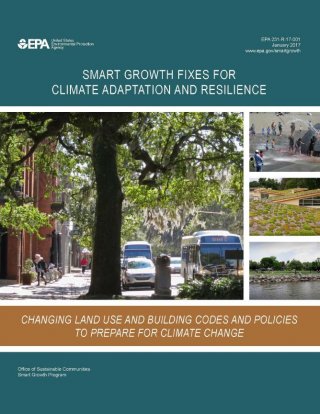
Cover of Smart Growth Fixes for Climate Adaptation and Resilience
Local governments are seeking ways to adapt to current and projected climate change impacts to better protect lives and property and ensure they can continue to offer a good quality of life and a thriving economy now and in the future. Smart Growth Fixes for Climate Adaptation and Resilience: Changing Land Use and Building Codes and Policies to Prepare for Climate Change (2017) can help local government officials, staff, and boards find strategies to prepare for climate change impacts through land use and building policies.

The policy options described in this publication bring multiple short- and long-term environmental, economic, health, and societal benefits that can not only prepare a community and its residents and businesses for the impacts of climate change, but also improve everyday life.

The strategies can be worked into a community’s regular processes and policies—for example, through scheduled updates to zoning and building codes. This approach allows incremental change, which might be easier for some communities because it costs little or nothing extra compared to “business as usual” and gives communities the opportunity to adjust codes based on the most up-to-date climate observations and projections.

To help readers determine which policy and code changes might be appropriate for their community’s capacity, desire, and need to make changes, the options in each chapter are categorized as modest adjustments, major modifications, and wholesale changes. These categorizations are meant as basic guidance on the effort needed to implement a policy. What might be a modest adjustment for one town could be a major modification in another.

Because an important question to determine in building resilience is resilience of what to what, the publication is divided by impacts that communities are likely to face as the climate continues to change:

  • Chapter 2: Overcoming Barriers to Climate Adaptation discusses potential social and legal barriers.
  • Chapter 3: Overall Strategies discusses smart growth strategies that help adapt to multiple climate change impacts and that can be a foundation for the policies in subsequent chapters.
  • Chapter 4: Adapting to Flooding and Extreme Precipitation includes code and policy options that deal mainly with riverine flooding and managing stormwater to prevent flooding and water pollution. This chapter includes green infrastructure strategies that can also help communities cope with extreme heat and other policy options that are relevant to sea level rise.
  • Chapter 5: Adapting to Sea Level Rise includes strategies that are specifically related to higher storm surges and other impacts from sea level rise.
  • Chapter 6: Adapting to Extreme Heat discusses strategies to protect people from heat waves, including green building and energy efficiency.
  • Chapter 7: Adapting to Drought includes water conservation strategies for individual buildings as well as entire communities.
  • Chapter 8: Adapting to Wildfire focuses on smart growth and green building strategies to protect neighborhoods from fire damage.

Most chapters include quick tips called “practice pointers,” examples of communities implementing the policies, resources, and a “Guidance and Metrics” section that references relevant credit summary language and metrics from up to three community-scale sustainability rating systems.

Click here for a sortable table of the policy options included in the publication.

Learn more about smart growth and climate change.

Smart Growth Fixes for Climate Adaptation and Resilience is based on the model of two previous publications that give local governments specific changes they can consider to get the type of development they want:
  • Essential Smart Growth Fixes for Urban and Suburban Zoning Codes
  • Essential Smart Growth Fixes for Rural Planning, Zoning, and Development Codes
  • Smart Growth Fixes for Climate Adaptation and Resilience (pdf)
    231-R-17-001
  • Smart Growth Home
  • About Smart Growth
  • Examples of Smart Growth
  • Grants and Funding
  • Partnerships
  • Publications
  • Technical Assistance
  • Tools
  • Topics
  • Webinars, Videos, and Podcasts
  • Smart Growth in Your Community
Contact Us to ask a question, provide feedback, or report a problem.
United States Environmental Protection Agency

Discover.

  • Accessibility
  • Budget & Performance
  • Contracting
  • EPA www Web Snapshot
  • Grants
  • No FEAR Act Data
  • Privacy
  • Privacy and Security Notice

Connect.

  • Data.gov
  • Inspector General
  • Jobs
  • Newsroom
  • Open Government
  • Regulations.gov
  • Subscribe
  • USA.gov
  • White House

Ask.

  • Contact EPA
  • EPA Disclaimers
  • Hotlines
  • FOIA Requests
  • Frequent Questions

Follow.

Last updated on October 22, 2018