


Children's Health Publications
Resources for Parents
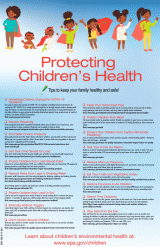
Protecting Children's Health Tips (pdf) : The poster provides a variety of tips and resources to protect children's health and help keep your family healthy and safe from environmental pollutants! Remember, children can be at increased risk to environmental contaminants compared to adults and can benefit from extra care and caution.
- Protegiendo la salud de los niños es un póster que incluye consejos y recursos para proteger la salud de los niños y ayudar a mantener a su familia sana y a salvo de contaminantes ambientales!
Protect Children, Protect Our Future (pdf) : Learning about common ways that children’s environmental health can be put at risk is the first step to protecting them. The booklet highlights risks from environmental exposure at home, school, and at play that can be reduced if care is taken to assure a healthy environment. Environmental risks that you can learn about in this booklet include air pollution, lead, mercury, water contaminants, radon, sun exposure and more.
Protecting Children's Health (pdf) : The brochure highlights some of EPA’s current initiatives to protect children where they live, learn, and play. Over the last 50 years, the agency has worked to fulfill its mission by improving the nation’s air, cleaning up our lands, ensuring that Americans have safe water for drinking and recreation, and providing a cleaner, healthier environment — especially for pregnant women, infants, and children who are in the most vulnerable life stages. View previous versions of the booklet
Climate Change and Children's Health (pdf) : The eight-page brochure describes the effects that climate change has on children's health, differentiated from its effects on adults. Some of the topics covered in this brochure include air quality, extreme weather, water- and food-borne illness, vector-borne diseases, and heat. The brochure also provides several things you can do now to prevent climate change including learning about your carbon footprint.

Live, Learn, Play - Tune Into Your Health and the Environment (pdf) : The booklet is a colorful, engaging guide that was prepared for youth groups and provides information about how to protect yourself and your friends. It includes fun activities (including a rap song) to spread the news about what you have learned and tips and resources to get more information.

Protecting Children from Lead Exposures booklet (pdf) : Since the 1970s, EPA and its state, tribal, and local governmental partners have made tremendous progress in reducing children’s lead exposures and lead-related health risks. EPA efforts to reduce lead exposures and prevent lead poisoning include a wide range of activities such as funding for community interventions and outreach, education and training, surveillance, and regulation and enforcement.
- Proteger a los niños de la exposición al plomo (PDF): Desde los 1970, la EPA y sus socios gubernamentales estatales, tribales, y locales han realizado enormes avances en la reducción de las exposiciones al plomo en los niños y en riesgos de salud relacionados al plomo. Los esfuerzos de la EPA por reducir las exposiciones al plomo y prevenir el envenenamiento por plomo incluyen una amplia gama de actividades tales como financiar esfuerzos comunitarios como intervenciones y de difusión, educación y capacitación, monitoreo, reglamentos y acatamiento.

What to Do If You Find or Spill Mercury (pdf) : Elemental mercury and mercury vapors are toxic to people and pets. Exposure can occur if not cleaned properly. Children and pregnant women are particularly susceptible to health effects from mercury exposure. Download the trifold or the bookmark.

Mercury Messes with the Environment (pdf) : The children’s activity booklet describes the effects of mercury contamination on humans and the environment.
- El mercurio causa problemas para el medioambiente (pdf) es un folleto de actividades para ninos que describe los efectos de contaminacion de mercurio para los seres humanos y el medio ambiente.
Resources for Schools

Sensible Steps to Healthier School Environments (pdf) : The brochure is designed to address some of the most common areas of environmental health concerns found in schools. It also provides one-stop access to learn some facts about these issues and the many existing low cost or no cost, affordable measures, programs and resources available to help prevent, reduce and resolve each of the highlighted environmental hazards.

Recipes for Healthy Kids and a Healthy Environment: This nine-lesson program was designed to excite kids about environmental health and empower them to take steps in their everyday lives to improve the environment for their community and reduce their environmental risk. It also contains classroom posters you can print to help teach kids about the environment.

Healthy Learning Environments in Schools Webinar: On October 14, 2026, the President’s Task Force on Environmental Health Risks and Safety Risks to Children hosted a webinar on environmental hazards in schools. The webinar highlighted priority school exposures — from lead and PCBs to pesticides, mold, outdoor air pollution, indoor air quality, and natural disasters — and shared federal tools and guidance on how to implement best practices that reduce exposure.
Find additional resources and publications for schools.
Children's Health Disparities Fact Sheets
These fact sheets provide information on the relationship between the environment, asthma and secondhand smoke among black and African American children and Hispanic and Latino children, as well as actions that can be taken to protect all children.
- Children’s Environmental Health Disparities: Black and African American Children and Asthma (pdf)
- Children’s Environmental Health Disparities: Hispanic and Latino American Children and Asthma (pdf)
- Children’s Environmental Health Disparities: Black and African American Children and Secondhand Smoke (pdf)
- Children’s Environmental Health Disparities: Hispanic and Latino American Children and Secondhand Smoke (pdf)
Find References for Children's Environmental Health Disparities fact sheets (pdf) .
Healthy Homes
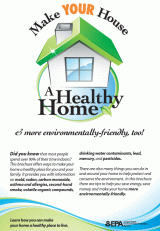
Make Your House a Healthy Home (pdf) : The brochure and the Healthy Home Action Card (English) (pdf) include tips to save energy, save money, and make your home more environmentally friendly. The brochure covers important keys to maintaining a healthy home including mold clean up, radon and carbon monoxide monitoring and prevention, managing asthma and allergies, reducing second-hand smoke, avoiding drinking water contaminants and more.
- Haga de Su Casa un Hogar Más Sano Folleto (pdf) y Haga de Su Casa un Hogar Más Sano Tarjeta (pdf) son recursos de consejos para ahorrar energía, ahorrar dinero y hacer que su casa sea más respetuosa con el medio ambiente.
Resources for Healthcare Professionals

A Network of Experts on Children's Environmental Health (pdf) : This brochure provides a general introduction to the Pediatric Environmental Health Specialty Unit (PEHSU) network. PEHSUs offer advice and information on environmental exposures on children's health.
- Una red de expertos en salud ambiental reproductiva e infantil (pdf) es un folleto que contiene una introducción general a la red PEHSU. PEHSUs ofrecen asesoramiento e información sobre las exposiciones ambientales en la salud infantil.

Promoting Good Prenatal Health: Air Pollution and Pregnancy (pdf) : This booklet identifies common environmental exposures and provides simple steps that healthcare providers can recommend to pregnant women and new mothers to avoid exposure.
Previous Publications
Pediatric Environmental Health Specialty Units (PEHSUs)

Find more information on the PEHSU website and view the resource library.
- Children's Environmental Health Newsletters (2018-2019)
- Office of Children's Health Protection: Publications Catalog (August 2010) (pdf)
- Children's Environmental Health: 2008 Highlights (pdf)
- Children's Environmental Health: 2007 Highlights (pdf)
- Children's Environmental Health: 2006 Report; Environment, Health, and a Focus on Children (pdf)
- Children’s Environmental Health 2005 (pdf)
- Children's Environmental Health: A Call for Global Protection (2002) (pdf)
- Children's Environmental Health Yearbook Supplement (August 2000) (pdf)
- Child Health Champion Resource Guide (1999) (pdf)
- The EPA Children’s Environmental Health Yearbook (1998) (pdf)