


Planning for and Managing Sargassum Inundation Events (SIEs)
Related information in Spanish
Since 2011, many governments and businesses in the coastal communities around the Gulf of America and Caribbean have been interested in understanding how to predict, plan for and address the large amounts of Sargassum washing up near and on their shores. Researchers are working on tools for forecasting SIEs to help with preparedness and management.
Once Sargassum inundates beaches and coastal areas, communities face challenging decisions on the logistics of relocating, removing, disposing or using the Sargassum biomass to create sustainable or profitable products.
EPA encourages communities at risk for SIEs to plan for the management of Sargassum before an event occurs and develop an emergency response plan. Planning for an SIE allows communities to consider and address, in advance, issues they may encounter during an event, improving the efficiency, effectiveness and sustainability of a response. It is important to plan for managing Sargassum as sustainably as possible (e.g., repurposing, recycling, composting) to reduce the amount of waste and preserve valuable, limited resources and landfill space. Learn about EPA’s Waste Management Hierarchy
Communities should be aware of any relevant federal, state, territorial, tribal or local regulations when managing Sargassum. Check with state, territorial, or tribal agencies for any Sargassum-specific best practices and guidance and share information with neighboring jurisdictions.
On this page:
Forecasting SIEs
SIEs associated with the Great Atlantic Sargassum Belt (GASB) are of international, regional, and local concern. Most jurisdictions are interested in forecasting specific landing, beaching, or inundation locations for the purposes of preparedness and management. While satellite-based monitoring provides accurate information on the general abundance and distribution of Sargassum aggregations from the GASB, specific inundation locations and impacts to coastal waters and beaches are more difficult to predict. This adds to the challenge of managing the increasing frequency and size of these events. Forecasting SIEs to specific locations is extremely difficult because it depends on the winds, tides, and ocean circulation, which are unpredictable. However, the likelihood for a potential landing can be predicted regionally using historical and current satellite observations.
NOAA’s CoastWatch for the Atlantic region and the University of South Florida’s Optical Oceanographic Lab have developed statistically-based Sargassum Inundation Risk reports that predict the likelihood of SIEs in the Tropical Atlantic and the Gulf of America.
Texas A&M University at Galveston developed a forecasting system to help predict SIEs in the U.S. Gulf Coast, Mexico, Grand Cayman, Jamaica, Haiti, Saba, the Dominican Republic, and Puerto Rico. This Sargassum Early Advisory System can forecast inundation events up to eight days in advance.
Collection and Removal of Sargassum
Regulatory Landscape
Commercial harvesting of Sargassum in federal waters (between 3 miles to 200 nautical miles offshore) in the South Atlantic is strictly prohibited under federal fisheries regulations, with additional rules on allowable seasons and gear for harvest. Individual U.S. states and territories may have their own permitting requirements and restrictions for Sargassum collection within nearshore state waters. In the Southeast U.S., Gulf of America, and U.S. Caribbean, Sargassum is designated as Essential Fish Habitat (EFH) for several open sea fish species under the Magnuson-Stevens Fishery Conservation and Management Act. Sargassum designation as EFH means it is considered a “substrate necessary to fish for spawning, breeding, feeding, or growth to maturity.” Sargassum is also designated as Critical Habitat for loggerhead sea turtles under the Endangered Species Act in two distinct areas of the U.S. South Atlantic and Gulf of America. These protected habitat designations of Sargassum legally limit its mitigation and management until it is fully beached. Additionally, the vast size of the incoming Sargassum mats and their constant movement with ocean currents present challenges to managing them.
NOAA has published an Overview of the Regulatory Framework for Strategies for Management of Sargassum Inundation Events in the United States.
It is important that communities experiencing an SIE work with all affected state, tribal, territorial and local jurisdictions when making management-related decisions. These jurisdictions may have a management plan or guidance for Sargassum that can help direct the cleanup.
Collection and Removal of Sargassum from Near-coastal Waters
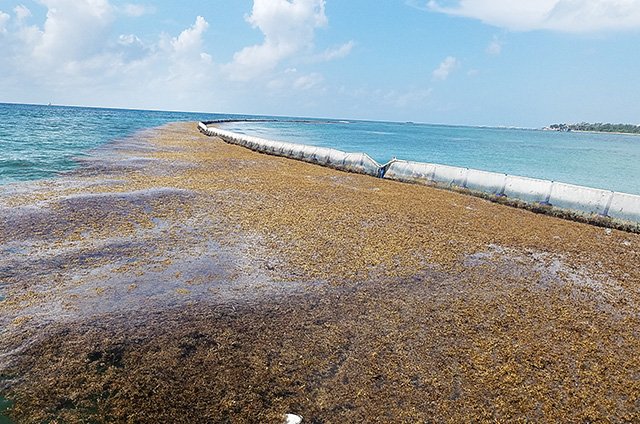
Some international jurisdictions in the tropical Atlantic collect and remove Sargassum from nearshore waters, prior to landing in coastal areas and beaches, but still dispose of it onshore as it is generally not practical to store on floating platforms or dispose of in the ocean. Some best practices used in removing and collecting Sargassum from nearshore waters include:
- Collect directly from the water to prevent sinking of dead or dying Sargassum.
- Collect in a manner that minimizes taking sand during the process; remove any sand from the collected Sargassum.
- Set clear guidelines for the process to avoid disturbing or harming marine life.
- Check for trapped marine life (e.g., baby turtles).
- Ensure that vessel storage areas and capacities are appropriately sized.
- Alert users of the areas where removals will occur.
An alternative to removing Sargassum from the waters near shore is restricting Sargassum mats from reaching the beach/coastline by deflecting them offshore using containment booms and other barriers, which have been used with mixed results. The U.S. Army Corps of Engineers should be consulted before any physical barriers are placed in near-shore environments that may impact navigation.
Collection, Relocation, and Removal of Sargassum from Beaches
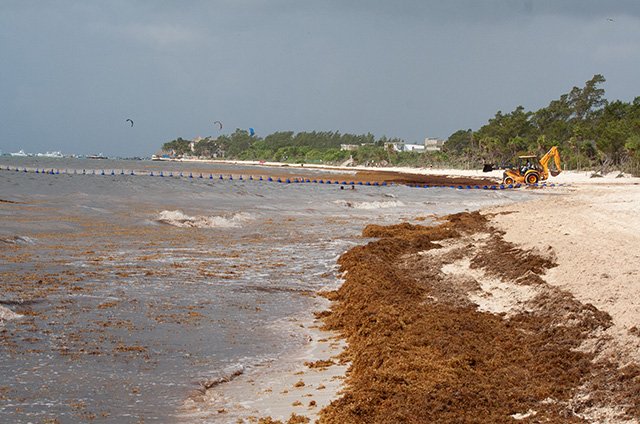
Some jurisdictions choose to leave Sargassum on the beach where it landed, or incorporate it into the sand, or relocate it to a less populated area of the beach. Many jurisdictions, including those within the U.S., collect and remove Sargassum soon after it washes onto beaches and before it decomposes. This is because Sargassumcan bioaccumulate and leach pollutants, and release gases when it decomposes. So, reducing potential exposure helps protect the health and safety of workers, volunteers, residents and the public.
Anyone handling Sargassum, particularly workers that collect and transport it from the beach to alternative locations, should consider wearing protective clothing such as gloves, boots, and respiratory protection as a precaution. Learn more about health impacts at: Sargassum Inundation Events: Impacts on Human Health.
Some best practices used in collecting and removing Sargassum from beaches are:
- Remove it as quickly as possible to avoid accumulation and decomposition on the beach.
- Prioritize essential areas to be cleaned and coordinate the activities among adjacent property owners and disposal sites to speed the process.
- Develop a plan to minimize erosion, removal of native vegetation and wildlife disturbance.
- Avoid the use of chemicals.
- Plan and implement measures to ensure cleanup of beached Sargassum, either manually or mechanically, to minimize worker exposure risks.
- For mechanical removal, use equipment capable of adjustments that minimize sand displacement and removal.
Staging, Storage, and Transport
Before being transported to an appropriate management facility, the Sargassum may need to be staged or stored at a temporary management site for several reasons. These reasons may include:
- Providing time and space for processing (e.g., removing sand and other debris) and volume minimization (e.g., dewatering), or
- Lacking enough transporters or available capacity at facilities for treatment and/or disposal (e.g., composters, landfills).
In selecting the locations for these sites, communities should consider the impacts to neighboring areas and the health and safety of workers and residents. Engineering controls and environmental monitoring may be necessary at temporary staging and storage sites to protect air, soil, and water. Communities may want to work with interested parties to choose the best locations for these temporary sites.
Disposal of Sargassum
The disposal of massive amounts of Sargassum that accumulates on beaches presents several challenges. Once Sargassum washes ashore, hoteliers and local governments usually remove it and pile it away out of sight from tourists or dispose of it in landfills. Both practices require the collection of excess Sargassum biomass from the beach, which is usually carried away with heavy machinery, leading to an increased risk of sand erosion. In addition, Sargassum decomposition is known to produce hydrogen sulfide and ammonia and its leachates contain bioaccumulated metals (particularly high concentrations of arsenic), pesticides, and other pollutants. As a result, certain measures should be considered during disposal to minimize potential human and environmental health effects:
- Air quality should be monitored in disposal and adjacent areas to assess exposure to hydrogen sulfide and ammonia
- Disposal areas, particularly unlined landfills located on karst substrates, should be tested for metals, pesticides, or pollutants of concern as their leachates may contaminate ground water
- Salinization of soils by salt on Sargassum can degrade soils and vegetation, so consider washing Sargassum prior to disposal if that is a concern in the disposal area
Disposal of Sargassum also has economic consequences. Landfill capacity is often limited on many tropical islands and in near-coastal communities and thus may be expensive. In addition, the cost to transport collected materials to landfills or other central locations can be expensive. Given possible alternative uses for Sargassum and landfill capacity limitations, landfill disposal of Sargassum should be considered as a last resort and preferably in landfills with leachate and gas controls.
Disposing Sargassum in the ocean may be explored as a potential management method during SIEs. Proposals to sink or dispose of Sargassum in ocean waters, including under emergency circumstances, may require authorization under a Marine Protection, Research and Sanctuary Act (MPRSA) permit from the EPA. Learn more about MPRSA permits and the types of activities that may require an MPRSA permit at: Marine Protection, Research and Sanctuary Act Permits: Frequently Asked Questions.
Potential Uses of Sargassum
As the geographic extent and duration of blooms from the GASB increase, many jurisdictions have begun to explore novel uses for excess Sargassum biomass with the hope of turning it into economic opportunities. Some potential, but largely unstudied, proposed uses identified for Sargassum include:
- Compost and fertilizer
- Biosorbent
- Bioplastics
- Biochar/charcoal briquettes
- Adobe bricks
- Cement additive (for strength and elasticity)
- Chipboard
- Livestock and fish food
- Biofuels
- Nanostructure materials
- Soap
- Pharmaceuticals and food supplements
The use and commercial application of Sargassum should take into consideration many factors including its capacity to bioaccumulate or leach metals (particularly, high concentrations of arsenic), metalloids, pesticides, and other pollutants such as microplastics. Additional factors to consider may include the need to remove sand, salt, and water prior to processing, as well as the potential need for long-term storage to deal with excess biomass and ensure a steady supply of Sargassum in the offseason.
EPA Planning Tools for Sargassum Management
EPA’s All-Hazards Waste Management Planning Tool helps communities create a pre-incident plan for managing materials and wastes generated from disasters. It can be used to develop a management plan for Sargassum before an SIEoccurs. Communities can document how they would manage Sargassum should an event impact them (e.g., on-site versus off-site options, reuse and recycling versus disposal). Through the tool, communities can identify short- and long-term staging and storage sites, transporters, and management facilities, for example.
Communities can also search for recyclers, composters, and waste management facilities using the Disaster Debris Recovery Tool and the Incident Waste Decision Support Tool. When choosing management options, communities should keep in mind EPA’s Waste Management Hierarchy, which has a preference for source reduction, reuse, recycling, and composting options. Potential waste management facilities should be contacted in advance to determine their acceptance criteria for Sargassum.
By planning in advance for the management of Sargassum, communities can:
- Save valuable time and resources during an SIE.
- Conserve limited landfill disposal capacity by identifying alternative options.
- Encourage interested parties (e.g., state, tribal, territorial and local governments; waste management facilities; community organizations; residents; businesses) to work together.
Learn more on EPA’s Pre-Incident Material and Waste Management Planning webpage.
Emergency Management of SIEs
In those instances where Sargassum Inundation Events become an emergency (i.e., involve a threat or damage to human health or life, to property, or to the environment), NOAA has developed an addendum to their “Guide to Integrated Disaster Resilience in the Southeast Caribbean.” The Guide as well as the SIEs Addendum are designed to help raise awareness of NOAA’s roles and responsibilities and promote coordination and effective communication during emergency situations among federal, state, and local agencies and within each NOAA line office. The purpose of SIEs Addendum is to provide background and contextual information on NOAA programs and resources that can be leveraged during an emergency response to SIEs; it includes contact information and resources for other federal agencies and the public in the event of an emergency related to Sargassum.
- NOAA's Disaster Guide for the Southeast and Caribbean
- NOAA's Sargassum Inundation Event (SIE) Disaster Guide
In addition, EPA's Office of Land and Emergency Management (OLEM) has a range of tools to support communities with waste management during emergency responses, including a webinar on Waste and Materials Management During Emergency Response. To facilitate planning and the proper management of disaster wastes and materials, EPA developed several waste planning and management tools for chemical, biological, radiological, or nuclear incidents and natural disasters. This suite of tools can assist decision makers with waste management decisions in the pre-planning, mitigation, response, and recovery phases of an incident. This webinar provides an overview of several EPA tools currently available to support decision making and planning for waste management following a large-scale event.
Organizations with Sargassum Management Information
- NOAA Coordinating Management Efforts and Response to Sargassum Inundation Events.
- University of South Florida- Satellite-based Sargassum Watch System (SaWS)
- United Nations Environment Programme- Sargassum White Paper: Turning the crisis into an opportunity
- Sargassum Information HUB- Protocols and Guides to Manage Sargassum
- Sargasso Sea Commission
- Center for Resource Management and Environmental Studies at The University of the West Indies Barbados
References:
- Abdool-Ghany, A. A., Pollier, C. G., Oehlert, A. M., Swart, P. K., Blare, T., Moore, K., & Solo-Gabriele, H. M. (2023). Assessing quality and beneficial uses of Sargassum compost. Waste Management, 171, 545-556.
- Caribbean Alliance for Sustainable Tourism (CAST). (2015). Sargassum: A Resource Guide for the Caribbean. CAST, Caribbean Hotel and Tourism Association, Coral Gables, FL.
- Carrillo-Domínguez, S., Rodríguez-Martínez, R. E., Díaz-Martínez, M., Magaña-Gallegos, E., Cuchillo-Hilario, M. (2022). Potential application of pelagic Sargassum spp. in animal feeding. J Appl Phyc, 35, 433-444.
- Dutch Caribbean Nature Alliance (DCNA). (2019). Prevention and clean-up of Sargassum in the Dutch Caribbean. DCNA, Bonaire, Dutch Caribbean.
- Devault, D. A., Pierre, R., Marfaing, H., Dolique, F., & Lopez, P. J. (2020). Sargassum contamination and consequences for downstream uses: a review. Journal of Applied Phycology, 33, 567-602.
- Endangered and Threatened Species: Critical Habitat for the Northwest Atlantic Ocean Loggerhead Sea Turtle District Population Segment (DPS) and Determination Regarding Critical Habitat for the North Pacific Ocean Loggerhead DPS, 79 Fed. Reg. 39856 (July 10, 2014) (to be codified at 50 CFR 226).
- Hinds, C., Oxenford, H., Cumberbatch, J., Fardin, F., Doyle, E., & Cashman, A. (2016). Sargassum management brief: Golden Tides: Management best practices for influxes of Sargassum in the Caribbean with a focus on clean-up. Centre for Resource Management and Environmental Studies (CERMES), The University of the West Indies, Cave Hill Campus, Barbados.
- López-Contreras, A., Núñez Valenzuela, P. N., García, B. C., Driegen, J., Huerta Lwanga, E., Domin, P., Polett Gurrola, M., Rosas-Luis, R., Verde Gómez, Y., & De Vrije, T. (2022). Sargassum in Mexico: From environmental problem to valuable resource. Wageningen Food & Biobased Research. Wageningen, Netherlands.
- Magnuson-Stevens Fishery Conservation and Management Act et seq., 16 U.S.C. §§1801-1891d (1976).
- Major. A., Margiotta, E., Green, D., Lorenzoni, L., & McClain, S. (2020). Vulnerability assessment of Sargassum impacts on the Caribbean [Final Report - Draft]. National Aeronautics and Space Administration Internship Program, Summer 2020.
- Milledge, J. J., Maneein, S., Arribas López, E., & Bartlett, D. (2020). Sargassum inundations in Turks and Caicos: Methane potential and proximate, ultimate, lipid, amino acid, metal and metalloid analyses. Energies, 13, 1523.
- Modestin, E., Devault, D. A., Baylet, A., Massat, F., & Dolique, F. (2022). Arsenic in Caribbean bivalves in the context of Sargassum beachings: A new risk for seafood consumers. Environ Monit Assess, 194, 553.
- National Oceanographic and Atmospheric Administration, Fisheries Southeast Regional Office (NOAA, SERO). (2023). Frequently asked questions regarding annual inundations of Sargassum in the Southeastern United States [Q & A]. National Oceanographic and Atmospheric Administration.
- South Atlantic Fishery Management Council (SAFMC). (2002). Fishery Management Plan for Pelagic Sargassum Habitat of the South Atlantic Region. South Atlantic Fishery Management Council. Charleston, South Carolina.
- Stevenson, M. (2022, May 3). Mexico’s Caribbean beaches awash in foul-smelling Sargassum algae. Chicago Sun Times.
- Tapia-Fuentes, J., Cruz-Salas, A. A., Martínez-Salvador, C., Ojeda-Benítez, S., Vázquez-Morillas, A., & Álvarez-Zeferino, J.C. (2023). Presence of microplastics deposited in Sargassum sp. on sandy beaches. Regional Studies in Marine Science, 66, 103152.
- Trench, C., Thomas, S. L., Thorney, D., Maddix, G. M., Francis, P., Small, H., ... & Webber, M. (2022). Application of stranded pelagic sargassum biomass as compost for seedling production in the context of mangrove restoration. Frontiers in Environmental Science, 10, 932293.
- Vázquez-Delfín, E., Freile-Pelegrín, Y., Salazar-Garibay, A., Serviere-Zaragoza, E., Méndez-Rodríguez, L. C., & Robledo, D. (2021). Species composition and chemical characterization of Sargassum influx at six different locations along the Mexican Caribbean coast. Sci Total Environ., 795, 148852.
- Wang, M., & Hu, C. (2016). Mapping and quantifying Sargassum distribution and coverage in the Central West Atlantic using MODIS observations. Remote Sensing of Environment, 183, 350-367.
- Wang, M., Hu, C., Cannizzaro, J., English, D., Han, X., Naar, D., Lapointe, B., Brewton, R., & Hernandez, F. (2018). Remote sensing of Sargassum biomass, nutrients, and pigments. Geophysical Research Letters, 45, 12,359-12,367.