


What Are the Effects of HABs
Human Health Effects Caused by the Most Common Toxin-producing HABs Species
When people are exposed to cyanobacterial toxins in freshwater, adverse health effects may range from a mild skin rash to serious illness or in rare circumstances, death. Acute illnesses caused by short-term exposure to cyanobacteria and cyanotoxins during recreational activities include hay fever-like symptoms, skin rashes, and respiratory and gastrointestinal distress. Table 1 summarizes the acute health effects caused by common cyanobacteria toxins.
| Toxin(s) | Acute Health Effects in Humans | Common Species of Toxin-producing Cyanobacteria |
|---|---|---|
| Microcystin-LR | Abdominal pain, headache, sore throat, vomiting and nausea, dry cough, diarrhea, blistering around the mouth, and pneumonia | Microcystis, Dolichospermum (previously Anabaena), Nodularia, Planktothrix, Fischerella, Nostoc, Oscillatoria, and Gloeotrichia |
| Cylindrospermopsin | Fever, headache, vomiting, bloody diarrhea | Raphidiopsis (previously Cylindrospermopsis) raciborskii, Aphanizomenon flos-aquae, Aphanizomenon gracile, Aphanizomenon ovalisporum, Umezakia natans, Dolichospermum bergii, Dolichospermum lapponica, Dolichospermum planctonica, Lyngbya wollei, Rhaphidiopsis curvata, and Rhaphidiopsis mediterranea |
| Anatoxin-a group | Tingling, burning, numbness, drowsiness, incoherent speech, salivation, respiratory paralysis leading to death (experimental animals) | Chrysosporum (Aphanizomenon) ovalisporum, Cuspidothrix, Raphidiopsis, Cylindrospermum, Dolichospermum, Microcystis, Oscillatoria, Planktothrix, Phormidium, Dolichospermum flos-aquae, A. lemmermannii Raphidiopsis mediterranea (strain of Raphidiopsis raciborskii), Tychonema and Woronichinia |
Treatment for People Who Have Been Exposed to Cyanobacterial Toxins
If you do come into contact with water that is known to be contaminated with cyanobacteria and/or cyanotoxins, the U.S. Centers for Disease Control and Prevention (CDC) recommends that you rinse off with clean, fresh water as soon as possible. If you may have symptoms caused by exposure to cyanobacterial HABs the CDC recommends that you:
Talk to your healthcare provider for advice about how to relieve your symptoms. Let them know that you might have recently come in contact with cyanobacteria or its toxins. Information about the suspected cause of your illness might help your healthcare provider manage your symptoms.
Call the national, toll-free Poison Help line, 1-800-222-1222, which connects you to your local poison center and is your resource for help in a poisoning emergency. The specialists might be able to provide information about illnesses caused by cyanobacteria.
Report any illnesses that you believe were caused by cyanotoxins to your local or state health department. This can help them understand and prevent illnesses caused by cyanobacteria. It may also help prevent someone else from getting sick. Some state health departments have forms on their websites or hotlines for reporting illnesses directly to the health department.
Seek medical treatment right away if you or someone you know might have been poisoned by toxins, especially when any of the symptoms previously mentioned are recognized.
Human and animal health care providers interested in more information should refer to the CDC webpages on harmful algae:
Human Health Effects Caused by the Most Common Toxin-producing Marine HABs Species
People are primarily exposed to marine toxins by eating seafood in which the algal toxins have accumulated, although one species’ toxin is known to be aerosolized leading to inhalation exposure. There are a variety of marine toxins, but most result in gastrointestinal or neurologic health effects. Table 2 summarizes the health effects caused by common marine HAB toxins. Learn more about marine HAB species through the US National Office for Harmful Algal Blooms at Woods Hole:
| Toxin | Syndrome | Acute Health Effects in Humans | Taxa |
|---|---|---|---|
| Domoic Acid | Amnesic Shellfish Poisoning | Gastroenteritis symptoms (usually within 24h after eating toxic shellfish): nausea, vomiting, abdominal cramps, and diarrhea. In severe cases, neurological symptoms (usually within 48h of eating toxic shellfish): dizziness, confusion, headache, seizures, disorientation, hallucinations, short-term memory loss, profuse respiratory secretions, cardiac arrhythmias, respiratory difficulty, and possibly coma. Short term memory loss can be permanent. | Pseudo-nitzschia spp. |
| Ciguatoxin | Ciguatera Poisoning | Gastrointestinal symptoms (e.g., diarrhea, vomiting, and abdominal pain) occur first, followed by neurological dysfunction (e.g., muscular aches and pain, itching, dizziness, difficulty concentrating or hallucinations, sweating, and numbness and tingling of the mouth, toes, or fingers, and reversal of temperature sensation in the mouth), burning or metallic taste in the mouth, or aching teeth. Cardiovascular symptoms, such as low blood pressure or heart rate are uncommon, with the exception of those associated with regional CP in the Pacific. | Gambierdiscus spp. |
| Okadaic Acid | Diarrhetic Shellfish Poisoning | Gastrointestinal symptoms usually within two hours of eating toxic shellfish. Symptoms include incapacitating diarrhea, nausea, vomiting, and abdominal pain, possibly chills, headache, and fever. | Dinophysis spp., Prorocentrum sp. |
| Brevetoxin | Neurotoxic Shellfish Poisoning | NSP presents as gastrointestinal and neurological symptoms resembling mild ciguatera or paralytic shellfish poisoning, 30 minutes to 3 hours after a person eats shellfish. Formation of toxic aerosols off bloom waters can produce asthma-like symptoms. | Karenia brevis |
| Saxitoxin | Paralytic Shellfish Poisoning | Rapid neurological symptoms appearing ten minutes to three hours after eating toxic seafood. Symptoms include tingling, numbness, and burning of the mouth and lips, ataxia, irregular heart beat, giddiness, drowsiness, fever, rash, and staggering. Can be accompanied by abdominal pain, nausea, vomiting and diarrhea. Severe cases result in respiratory arrest within 24h. | Alexandrium spp., Gymnodinium sp., Pyrodinium sp. |
Learn more about marine HAB-associated human health effects through the CDC:
Treatment for People Who Have Been Exposed to Marine Toxins
If you may have symptoms caused by consuming toxic seafood, the CDC recommends the following:
Talk to your healthcare provider for advice about how to relieve your symptoms. Let them know that you might have recently come in contact with a bloom or its toxins. While there are currently no available tests or special treatments for illnesses caused by algal toxins, information about the suspected cause of your illness might help your healthcare provider manage your symptoms.
Call the national, toll-free Poison Help line, 1-800-222-1222, which connects you to your local poison center and is your resource for help in a poisoning emergency. The specialists might be able to provide information about illnesses caused by blooms.
Report any illnesses that you believe were caused by algal toxins to your local or state health department. This can help them understand and prevent harmful algal blooms and illnesses. Some state health departments have forms on their websites or hotlines for reporting suspected bloom-associated illnesses directly.
Seek medical treatment right away if you or someone you know might have been poisoned by marine HAB toxins, especially when any of the symptoms previously mentioned are recognized.
Human and animal health care providers interested in more information should refer to the CDC webpages on harmful algae:
Ecosystem Effects Caused by HABs
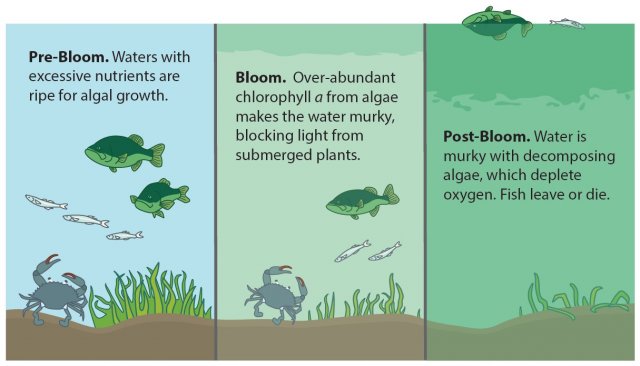
High biomass blooms, whether of toxic or nontoxic species, can lead to very low oxygen levels in the water column (hypoxia) or even no oxygen (anoxia), resulting in higher mortality rates for plant, invertebrate, shellfish and fish populations. Hypoxia/Anoxia can also alter biochemical reactions that may further exacerbate algal blooms and release other pollutants from sediments (e.g., metals).
Learn more about hypoxia at Hypoxia 101.
The hypoxia/anoxia can be accompanied by a decrease in pH (increase in acidity) in the water that can exacerbate ongoing acidification caused by climate change. The acidity of the water affects a wide range of processes, including the growth of healthy algae, shellfish, and fishes.
- Learn more at Ocean and Coastal Acidification
The same blooms may also affect benthic flora and fauna due to decreased light penetration. Low light levels negatively affect the growth of macrophytes, seagrasses and corals, upon which a wide range of other organisms depend. If low light levels persist, they can cause a regime shift in these ecosystems that then require expensive restoration efforts to reverse.
Some toxins and toxin producing taxa may actual inhibit other algae and suppress of zooplankton grazing, leading to reduced growth and reproductive rates. These impacts can be transmitted through the food web causing changes in the community structure and composition, including impacts to recreationally and commercially important fishes.