


EPA AirHub
Overview
What is the EPA AirHub?
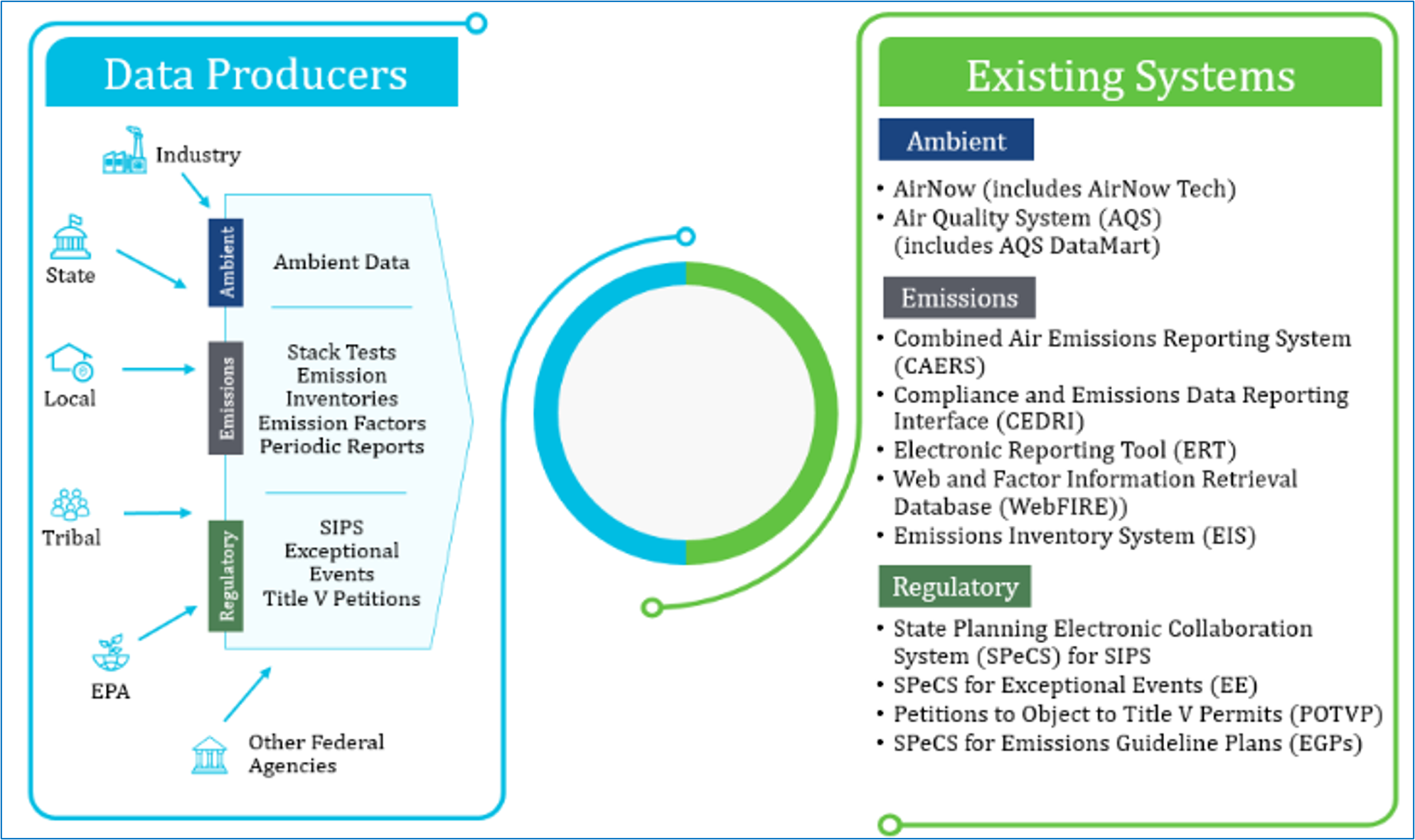
EPA AirHub, formerly referred to as the “Unified Platform Project,” is a multi-year effort to modernize how clean air data are collected, managed, and shared across EPA and state, local, and Tribal partners. EPA AirHub will bring together capabilities currently supported by several existing clean air data systems into a more integrated and efficient system designed to improve usability, reduce duplication, strengthen data sharing, and support Clean Air Act implementation.
EPA AirHub is organized into manageable components, or functionalities, across the following areas:
- Regulatory: Supports the collection, management, and exchange of regulatory data used to develop, review, approve, and track Clean Air Act plans, permits, rules, and compliance-related activities.
- Ambient: Supports the collection, validation, management, and dissemination of ambient air monitoring data used to assess air quality, inform human health decisions, and demonstrate compliance with air quality standards.
- Emissions: Supports the reporting, processing, management, and analysis of emissions data from stationary, mobile, and other sources used for inventories, planning, modeling, and regulatory decision-making.
When will EPA AirHub capabilities become available?
EPA is developing EPA AirHub incrementally, with initial releases planned for 2027. Current planning includes:
- May 2027 target: Regulatory – SIP State Interface, SIP EPA Interface, Reports and Dashboard.
- July 2027 target: Emissions – Shared Facility Inventory and Test Plan and Relative Accuracy Test Audit (RATA) Reporting.
- December 2027 target: Ambient – Monitoring Network Configuration, Data Submission, Quality Control, View and Manage Data.
- August 2026 - Future-State Ambient Data Format shared
- September 30, 2026 - Partner feedback
- 2026-2027 - Feature demonstrations and user testing
- December 2027 - Initial release target
Additional features, enhancements, and system capabilities are expected through 2028 and early 2029.
Project Roadmap
EPA is developing EPA AirHub incrementally. Each business line will move through design, development, user testing, release, and continued enhancement.
Regulatory
Initial 2027 capabilities
- SIPs State Interface
- SIPs EPA Interface
- Reports and Dashboards
Future capabilities
- Additional regulatory workflows
- Exceptional Events
- Petitions
- Additional user interfaces and reporting capabilities
Emissions
Initial 2027 capabilities
- Shared Facility Inventory
- RATA Reporting
Existing emissions reporting applications will continue operating while additional EPA AirHub capabilities are developed, tested, and prepared for implementation.
Future capabilities
- Additional facility and sub-facility capabilities
- Emissions Inventories
- Emissions Compliance Reporting
- Emissions Factors
- Emissions Stack Tests
Ambient
Initial 2027 capabilities
- Monitoring Network Configuration
- Data Submission
- Quality Control
- View and Manage Data
EPA plans to demonstrate and test Ambient features throughout development, including monitoring network configuration, data submission, error handling, quality control, and view and edit workflows.
Future capabilities
- Audit Scheduling
- Regulatory Requirements
- Additional ambient data management and reporting capabilities
From Development to Implementation
EPA will prepare users before the new EPA AirHub capabilities are put into production. Implementation activities may include user testing, readiness communications, training, user guides, demonstrations, transition information, and other support appropriate to each release.
More detailed testing and implementation information will be posted as individual releases approach.
Designs & Feedback
EPA AirHub is being designed with input from the people who will use it. As development progresses, EPA will use this page to share selected user experience designs, prototypes, workflows, and other materials for stakeholder review.
Materials may include:
- User interface designs
- Workflow concepts
- Prototypes
- Data exchange concepts
- Draft requirements or standards
- Early usability feedback opportunities
How Feedback Is Used
Stakeholder feedback helps EPA identify usability issues, validate workflows and requirements, and improve EPA AirHub before capabilities are released. Each feedback opportunity will identify the material being reviewed, who the review is intended for, the feedback period, and how comments should be submitted.
CURRENT FEEDBACK OPPORTUNITIES
- EPA AirHub Ambient Data Format Standard Documentation. Comments due by September 30, 2026.
PAST FEEDBACK OPPORTUNITIES
- Initial Data Standards Released on June 1, 2026. Comments were due by August 10, 2026.
Testing & Implementation
EPA AirHub will use a structured testing process to involve users before new system features are released. Testing will help EPA validate real-world workflows, identify usability or data issues, refine capabilities, and prepare users for implementation.
EPA plans to use a consistent approach across the Regulatory, Emissions, and Ambient business lines as capabilities become ready for testing.
User Acceptance Testing
User Acceptance Testing (UAT) brings together a focused group of users who understand the business process being tested. Participants will perform realistic tasks using structured test cases and provide feedback on what works, what does not work, and where improvements may be needed.
EPA reviews and prioritizes testing feedback and uses the results to refine workflows, data handling, system functions, and supporting guidance before release.
Beta Testing
As features becomes more complete, EPA expects to expand participation through Beta Testing. A broader group of users will have an opportunity to use the Minimum Viable Product (MVP) before production implementation.
Implementation Readiness
Testing is one part of preparing an EPA AirHub feature for implementation. EPA will also provide appropriate implementation support before release:
- Training
- User guides
- Readiness communications
- Demonstrations
- User support information
- Transition guidance
Specific testing and implementation activities will vary by business line and release.
How the Process Works
Review → Demonstrate → Test → Refine → Validate → Implement
EPA will share testing opportunities, schedules, participation information, and implementation resources on this website as they become available.
Upcoming Testing
Regulatory - SIP State Interface
User Acceptance Testing is planned for October 2026. EPA will seek participants who understand state SIP submission workflows and can test the feature using realistic business scenarios.
Additional Regulatory Testing
Additional User Acceptance Testing for the SIP EPA Interface, Reports, and Dashboards is planned for February 2027.
Emissions and Ambient
Testing opportunities for Emissions and Ambient capabilities will be announced as those features become ready for structured testing.
Stakeholder Resources
Find EPA AirHub presentations, project information, meeting materials, and implementation resources.
Featured Resources
- EPA AirHub Project Overview 2026 (pdf) – Learn about the scope, business case, and vision of EPA AirHub.
Meeting Summaries & Presentations
Materials and summaries from MJO meetings, stakeholder engagements, and project briefings.
- EPA AirHub Project Quarterly Webinar Slides (August 19, 2026) (pdf)
- Meeting Recording: AAPCA-NACAA-ECOS-EPA Call on Unified Platform Project: Initial Regulatory, Emissions & Ambient Data Standards Artifacts (July 9, 2026)
- Spring 2026 MJO Meetings: EPA AirHub Project Updates (pdf) – Slides presented during Spring 2026 Multi-Jurisdictional Organization (MJO) meetings.
- Fall/Winter 2025 Listening Sessions Summary (pdf) – Summary of feedback received during listening sessions held by EPA in the Fall/Winter of 2025. Sessions were across the ambient, emissions, and regulatory business lines to inform the EPA AirHub Project.
Implementation & Planning Resources
Future onboarding guidance, implementation planning documents, release readiness materials, and training resources.
Upcoming Engagements
EPA will continue engaging state, local, Tribal agencies, EPA, industry, and other stakeholders throughout EPA AirHub design, development, testing, and implementation activities.
| Date | Activity |
|---|---|
| September 30, 2026 | Ambient Data Format comments |
| October 8, 2026 | Emissions Business Line quarterly public meeting |
| October 2026 | SIP State Interface User Acceptance Testing |
| November 18, 2026 | Next EPA AirHub Quarterly Webinar |
Future Engagement Opportunities
Additional engagement opportunities, including user testing, design reviews, data and exchange reviews, and future quarterly webinars, will be posted as they are scheduled.
Data & Exchange Standards
EPA AirHub provides an opportunity to improve consistency and data exchange across EPA clean air programs and partner systems.
EPA is reviewing existing program data, business definitions, reference data, and exchange approaches as EPA AirHub features are designed and developed. Draft materials may be shared with stakeholders when feedback can help inform development.
Ambient Future Data Exchange
EPA is developing a future approach for exchanging ambient air monitoring data through EPA AirHub. The future exchange will support features currently provided through existing ambient air data systems while providing a more modern approach to submitting and exchanging information.
EPA introduced the future Ambient Data Exchange during the August 19, 2026, EPA AirHub Quarterly Webinar.
Previous Data Standards Engagement
In June 2026, EPA released initial draft materials for stakeholder review in three areas:
- Regulatory - SIPs State Interface
- Emissions - Facility-level Inventory
- Ambient - Monitoring Network Configuration
The initial review period has closed. EPA will continue refining these materials as EPA AirHub requirements and designs mature.
EPA is beginning initial data standards external engagement activities with each business line.
Initial Regulatory Data Standards Effort — SIPs
The following draft artifacts are being shared incrementally to support stakeholder awareness, collaboration, and feedback:
-
SIPs Conceptual Data Model (pdf)
High-level business objects, relationships, and cardinality for the Minimum Viable Product (MVP) scope. -
SIPs Data Map (State Interface Use Case) (pdf)
Expanded detail on shared and reference data elements associated with the State Interface use case, including draft EPA interface considerations. -
SIPs State Interface Draft Data Standards (xlsx)
Draft standards aligned to SIPs plan types and State Interface requirements. Additional EPA interface standards and mappings will be incorporated as requirements mature and legacy system analysis progresses.
Initial Ambient Data Standards Effort
The following draft artifacts are being shared incrementally to support stakeholder awareness, collaboration, and feedback:
-
Monitoring Network Configuration Conceptual Data Model (pdf)
High-level business objects, relationships, and cardinality for the Minimum Viable Product (MVP) scope. -
Monitoring Network Configuration Draft Data Standards (xlsx)
Draft standards aligned to the ambient monitoring configuration requirements. Additional data standards (for other functions currently in AQS, AirNow) and mappings will be incorporated as requirements mature and legacy system analysis progresses.
Initial Emissions Data Standards Effort — Facility Inventory (not sub-facility level)
The following draft artifacts are being shared incrementally to support stakeholder awareness, collaboration, and feedback:
-
Facility Inventory Conceptual Data Model (pdf)
High-level business objects, relationships, and data elements for the Minimum Viable Product (MVP) scope. -
Facility Inventory Conceptual Data Model (xlsx)
Draft standards aligned to the emissions facility-level inventory requirements. Additional data standards (for other functions of the legacy emissions systems) and mappings will be incorporated as requirements mature and legacy system analysis progresses.
EPA will continue coordinating with EPA, state and local agencies, Tribal partners, and industry stakeholders as these artifacts evolve and additional program areas are incorporated into the EPA AirHub Project modernization effort.
Questions and Answers
What is EPA AirHub?
EPA AirHub is a multi-year effort to modernize how clean air data are collected, managed, and shared across EPA and its partners. It was previously referred to as the Unified Platform Project.
When will EPA AirHub become available?
EPA plans to begin releasing initial EPA AirHub features in 2027. Regulatory, emissions, and ambient features will be released incrementally rather than through a single system launch.
Who will use EPA AirHub?
EPA AirHub will support EPA staff, state, local, and Tribal agencies, regulated entities, and other users of EPA clean air data and reporting systems. Specific users will vary by EPA AirHub capability.
Will existing (legacy) systems be retired?
EPA AirHub features will be implemented in a way that supports continuity of program operations and minimizes disruption for users. EPA will communicate transition and retirement plans for existing systems as new EPA AirHub features are tested, validated, and ready for implementation.
Where can I find the latest EPA AirHub information?
Check the What’s New, Upcoming Engagements, and Designs & Feedback sections of this web page for new information and opportunities to participate.
How will users be involved in testing EPA AirHub?
EPA will involve users as features becomes ready for testing. Depending on the stage of development, opportunities may include design reviews, demonstrations, User Acceptance Testing, and Beta Testing. EPA will seek participants who understand the business processes being tested and can provide feedback based on realistic use of the system.
How will users prepare for new EPA AirHub capabilities?
EPA will provide readiness information and support before new capabilities are implemented. Depending on the release, resources may include training, user guides, demonstrations, transition information, and other user support materials.
Will existing emissions systems be replaced in July 2027?
No. The July 2027 milestone is focused on initial Shared Facility Inventory and Test Plan/RATA capabilities. Existing emissions reporting applications will continue operating while additional EPA AirHub features are developed, tested, and prepared for implementation.
Contact Us
Questions, comments, or feedback about EPA AirHub can be sent to: up@epa.gov
When submitting feedback on a specific EPA AirHub design, data exchange, standard, or other posted material, please identify the material in the subject line of your email.