


Sustainable Management of Industrial Non-Hazardous Secondary Materials
The beneficial use of industrial non-hazardous secondary materials (secondary materials) is a key part of EPA's Sustainable Materials Management (SMM) effort. The appropriate beneficial use of secondary materials can advance the goals of EPA’s SMM program, which emphasizes a materials management approach that aims to reduce impacts to human health and the environment associated with materials over their entire life cycle (e.g., extraction, manufacture, distribution, use, disposal). Through SMM, EPA is helping change the way our society protects the environment and conserves resources for future generations.
On this page:
- What are Secondary Materials?
- What is Beneficial Use?
- How is the Beneficial Use of Secondary Materials Regulated?
- What EPA Resources are Available to Aid in the Determination of Whether a Beneficial Use is Appropriate?
- Additional Resources
What are Secondary Materials?
Secondary materials are any materials that are not the primary products from manufacturing and other industrial sectors. These materials can include scrap and residuals from production processes and products that have been recovered at the end of their useful life. Some common examples include:
- Coal combustion residuals generated by steam electric utilities
- Spent foundry sand generated by the metal casting sector
- Construction and demolition materials from the construction and demolition of buildings, roads and other infrastructure
What is Beneficial Use?
Each year the industrial sector creates hundreds of millions of tons of secondary materials that are sent for disposal, but some have the potential to be beneficially used instead. Beneficial use involves the substitution of these materials, either as generated or following additional processing, for some or all of the virgin materials in a natural or commercial product in a way that: provides a functional benefit; meets product specifications; and does not pose concerns to human health or the environment. Secondary materials can often be used as substitutes for virgin materials because they have many of the same chemical and physical properties as the materials they replace.
Examples of appropriate beneficial use applications include:
- Coal fly ash as a replacement for portland cement in concrete
- Flue gas desulfurization gypsum as a substitute for mined gypsum in wallboard
- Silica-based spent foundry sands from iron, steel, and aluminum foundries in soil-related applications, such as manufactured soil and road subbase
In addition, other secondary materials may be used in the construction of roads, bridges, buildings, and other infrastructure as structural fill, road embankments, flowable fill, and as aggregate in pavements and concrete.
Some of the potential benefits associated with the use of secondary materials include reduced costs, preservation of natural resources, reduced air and water pollution from extraction activities, and avoided use of landfill space. Because of the potential for numerous economic, environmental and performance benefits, the appropriate beneficial use of secondary materials can advance the goals of EPA’s SMM program.
How is the Beneficial Use of Secondary Materials Regulated?
State environmental agencies manage the beneficial use of secondary materials. Prior to beneficially using secondary materials in any projects, interested individuals or organizations should talk to the relevant state environmental agency to ensure proposed uses are consistent with state requirements. The Beneficial Use State Program Locator is a useful tool to identify individual state rules and programs related to beneficial use of secondary materials.
For coal combustion residuals, the Agency’s April 2015 CCR Disposal Final Rule promulgated a definition of beneficial use (in Title 40 of the Code of Federal Regulations section 257.53). This definition identifies four criteria that distinguish beneficial use from disposal (refer to Volume 80 of the Federal Register on page 21349). Those parties who propose a beneficial use for CCR should consult both this definition and the relevant state authorities to identify all the requirements that would apply.
What EPA Resources are Available to Aid in the Determination of Whether a Beneficial Use is Appropriate?
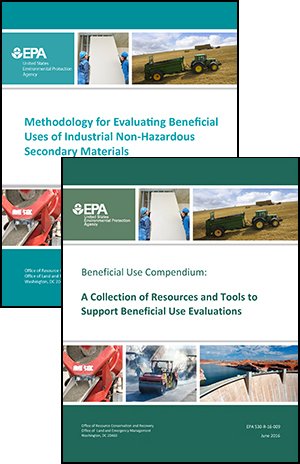
EPA has developed several tools to assist with addressing barriers to the beneficial use of secondary materials. EPA developed the Methodology for Evaluating Beneficial Uses (BU) of Industrial Non-Hazardous Waste Secondary Materials (BU Methodology) and the Beneficial Use Compendium: A Collection of Resources and Tools to Support Beneficial Use Evaluations (BU Compendium) to help evaluate the potential for adverse impacts to human health and the environment associated with the beneficial use of secondary materials. Together, the BU Methodology and BU Compendium are intended to help improve the consistency and quality of beneficial use evaluations. However, neither document is intended to be a detailed, step-by-step guide on how to conduct the evaluation for any particular beneficial use of a secondary material. Rather, these documents identify key questions to ask when designing or reviewing evaluations, as well as a list of tools and other resources that might be helpful. These two documents can help states and others conduct beneficial use evaluations of secondary materials.
EPA applied the methodology to evaluate the potential environmental impacts from fly ash used as a direct substitute for Portland cement in concrete and from FGD gypsum used as a replacement for mined gypsum in wallboard. The agency also has applied the analytical framework to evaluate the use of flue gas desulfurization (FGD) gypsum as an agricultural amendment. Read these evaluations:
- Coal Combustion Residual Beneficial Use Evaluation: Fly Ash Concrete and FGD Gypsum Wallboard.
- Beneficial Use Evaluation of Flue Gas Desulfurization (FGD) Gypsum in Agriculture.
Additional Resources
These additional resources are available to help with the other considerations in determining the appropriateness of a proposed beneficial use, such as how a secondary material substitutes for some or all of the virgin materials in a natural or commercial product in a way that provides a functional benefit. Also, there are resources listed below to help with additional considerations that may also factor into a beneficial use determination, such as obtaining community input when planning for a beneficial use project. Other federal agencies, states, and local governments may use different terms in discussing the beneficial use of secondary materials, such as “industrial byproducts” and “recycled materials.”
| Title | Description |
|---|---|
| Industrial Waste Management Evaluation Model (IWEM) Version 3.1 | IWEM is an EPA ground water screening model that consists of six modules used to evaluate the potential impacts to ground water resources associated with waste management practices of industrial materials, or the beneficial use of these byproducts. |
| Leaching Environmental Assessment Framework (LEAF) Test Methods and Guidance | LEAF is an EPA-developed leaching evaluation system, which includes four leaching test methods and data management tools. It can be used to estimate the environmental impacts from utilization of secondary materials. |
| User Guidelines for Waste and Byproduct Materials in Pavement Construction | This Federal Highway Administration document provides technical information on beneficially using waste and byproduct materials in pavement construction. |
| Recycled Materials Resource Center | The Recycled Materials Resource Center (RMRC) is a national center that provides information and resources to facilitate the appropriate use of recycled materials in the highway environment. The RMRC web site provides access to research efforts and results as well as other technical resources related to the use of recycled materials in transportation applications. |
| Office of Pavement Technology Recycling Homepage | One of the focus areas for the Federal Highway Administration’s (FHWA) Office of Pavement Technology is environmental stewardship, which includes recycling and reducing noise abatement. Their recycling website includes information on FHWA’s current projects and activities to facilitate the use of recycled materials in the highway environment. |
| BEES (Building for Environmental and Economic Sustainability) | BEES is a software tool, developed by the National Institute of Standards and Technology, for selecting cost-effective, environmentally preferable building products. |
| PaLate (Pavement Life-Cycle Assessment Tool for Environmental and Economic Effects) | PaLate is a computer-based decision support tool developed by the University of California, Berkeley’s Consortium on Green Design and Manufacturing. PaLate is for pavement designers and engineers, transportation agency decision-makers, civil engineers, and researchers, to model economic costs and environmental effects of using traditional highway materials and recycled materials for highway applications. |
| WARM (Waste Reduction Model) | The Waste Reduction Model is an EPA tool developed to help solid waste planners and organizations interested in comparing emissions, energy, and economic impacts from several waste management practices. Examples of industrial non-hazardous secondary materials that the Waste Reduction Model recognizes include: asphalt concrete, asphalt shingles, clay bricks, concrete, dimensional lumber, drywall, and fly ash. |
| RCRA Public Participation Manual | This EPA document provides tools for public participation and public outreach in environmental decision-making. |