


Storm Water Management Model (SWMM)
-

- Capabilities
- Applications
- Green Infrastructure/LID Controls
- Related Resources
- Technical Support
Disclaimer: Any mention of trade names, manufacturers, or products does not imply an endorsement by EPA. EPA and its employees do not endorse commercial products, services, or enterprises.
Estimates runoff quantity and quality in drainage systems
EPA's Storm Water Management Model (SWMM) is used throughout the world for decision support, emergency response, planning, analysis, and design related to stormwater, combined, and sanitary sewer systems as well as for other drainage systems. It can be used to evaluate gray infrastructure stormwater control strategies, such as pipes and storm drains, and is a useful tool for creating cost-effective hybrid green/gray stormwater control solutions. SWMM was developed to help support local, state, and national stormwater management objectives to reduce runoff through infiltration and retention and help to reduce discharges that cause impairment to receiving waterbodies.
Software and Documentation
SWMM provides a cross-platform desktop software and associated tools for drainage system modeling. It is an open source, publicly, and freely available software for use worldwide. SWMM 5 was originally developed through a joint development effort with CDM Smith Inc., and is currently maintained and advanced by the EPA's Office of Research and Development.
Software
|
Date |
Description |
|---|---|
| 08/07/2023 |
Self-Extracting Installation Program for SWMM 5.2.4 (32-bit) (exe) |
|
08/07/2023 |
Self-Extracting Installation Program for SWMM 5.2.4 (64-bit) (exe) |
Source Codes and Bug Fixes
|
Date |
Description |
|---|---|
| 08/07/2023 | SWMM 5 Updates and Bug Fixes (txt) |
| 08/07/2023 | Source Code for the SWMM 5.2.4 Computational Engine (zip) |
| 08/07/2023 | Source Code for the SWMM 5.2.4 Graphical User Interface (zip) |
| 08/07/2023 | SWMM 5.2.4 API Guide (zip) |
Manuals and Guides
| Date | Title |
|---|---|
| 08/01/2022 | SWMM Reference Manuals Errata (pdf) |
| 02/01/2022 | SWMM 5.2 User’s Manual (pdf) |
| 09/07/2016 | SWMM Applications Manual (zip)(7 MB) |
| 01/29/2016 | SWMM Reference Manual Volume 1- Hydrology (pdf) |
| 08/07/2017 | SWMM Reference Manual Volume II- Hydraulics (pdf) |
| 02/01/2022 | SWMM Reference Manual Volume II – Addendum (pdf) |
| 09/08/2016 | SWMM Reference Manual Volume III—Water Quality (pdf) (Includes description of the LID Module) |
| 09/2015 |
Other Documents
| Date | Title |
|---|---|
| 09/19/2006 | Quality Assurance Report for Dynamic Wave Flow Routing (zip)(3 MB) |
Previously Released Versions of SWMM
Capabilities
SWMM can be used for single event or long-term simulations of runoff quantity and quality in for drainage systems. SWMM provides an integrated environment for editing study area input data, running hydrologic, hydraulic and water quality simulations, and viewing the results in a variety of formats. These include color-coded drainage area and conveyance system maps, time series graphs and tables, profile plots, and statistical frequency analyses.
Hydraulic Modeling
SWMM contains a flexible set of hydraulic modeling capabilities used to route runoff and external inflows through the drainage system network comprised of pipes, channels, storage/treatment units, diversion structures, and other hydraulic structures. These include the ability to do the following:
- Handle arbitrarily sized drainage networks.
- Use a wide variety of standard closed and open conduit shapes as well as natural channels.
- Simulate hydraulic infrastructure, such as street inlet drains, storage/treatment units, flow dividers, pumps, weirs, and orifices.
- Apply external flows and water quality inputs from surface runoff, groundwater interflow, rainfall-dependent infiltration/inflow, dry weather sanitary flow, and user-defined inflows.
- Utilize either kinematic wave or full dynamic wave hydraulic flow routing methods.
- Simulate various flow regimes, such as backwater, surcharging, reverse flow, and surface ponding.
- Apply user-defined dynamic control rules to simulate and optimize the operation of pumps, orifice openings, and weir crest levels.
Accounting for Hydrologic Processes
SWMM accounts for various hydrologic processes that produce runoff from urban areas, which include the following:
- Runoff reduction via green infrastructure practices.
- Temporally and spatially varied rainfall (precipitation) and evaporation of standing surface water.
- Snow accumulation and melting.
- Rainfall interception from depression storage.
- Infiltration of rainfall into unsaturated soil layers.
- Percolation of infiltrated water into groundwater layers Interflow between groundwater and the drainage system.
- Nonlinear reservoir routing of overland flow.
Spatial variability for hydrologic processes is achieved by dividing a study area into a collection of smaller, heterogenous sub-catchment areas. Each of the areas contains its own fraction of pervious and impervious sub-areas. Overland flow can be routed between sub-areas, between sub-catchments, or to entry nodes in a drainage system.
Pollutant Load Estimation
SWMM can estimate pollutant wash-off loads associated with stormwater runoff. The following processes can be modeled for any number of user-defined water quality constituents:
- Dry-weather pollutant buildup over different land use types.
- Pollutant wash-off from specific land uses during storm events.
- Direct contribution of rainfall deposition. Reduction in dry-weather buildup due to street cleaning.
- Reduction in wash-off load due to best management practices (BMPs).
- Entry of dry weather sanitary flows and user-specified external inflows at any point in the drainage system.
- Routing of water quality constituents through drainage systems.
- Reduction in constituent concentration through treatment in storage units or by natural processes in pipes and channels.
Add-in Tool for Climate Projections
Note: Starting on March 18, 2025, the SWMM-CAT tool is no longer being maintained. Legacy codes and binaries will be archived on EPA’s Enterprise GitHub. Users are encouraged to use the upcoming NOAA Atlas 15 effort in lieu of SWMM-CAT.
SWMM includes a software utility that allows future climate change projections to be incorporated into modeling. The SWMM Climate Adjustment Tool (SWMM-CAT) provides a set of location-specific adjustments derived from World Climate Research Programme global climate change models. SWMM-CAT accepts monthly adjustment factors for climate-related variables that could represent the potential impact of future climate changes.
Applications
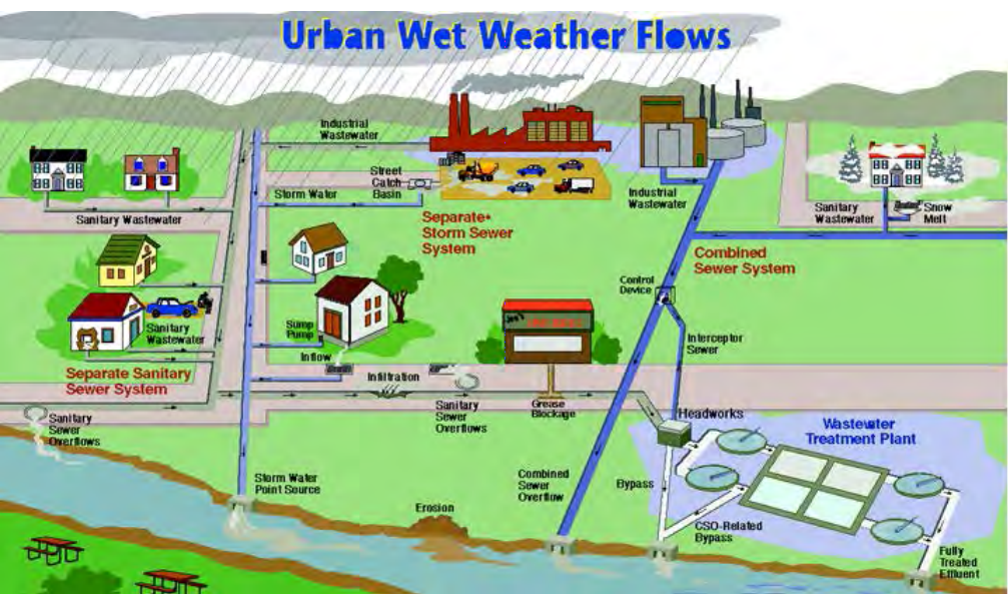
Typical applications of SWMM:
- Designing and sizing of drainage system components for flood control.
- Sizing detention facilities and their appurtenances for flood control and water quality protection.
- Mapping flood plains of natural channel systems—SWMM 5 is a FEMA-approved model for National Flood Insurance Program studies.
- Designing control strategies for minimizing combined sewer overflows.
- Evaluating the impact of inflow and infiltration on sanitary sewer overflows.
- Generating nonpoint source pollutant loadings for waste load allocation.
- Controlling site runoff using green infrastructure practices as low LID controls.
- Evaluating the effectiveness of best management practices and low impact development for reducing wet weather pollutant loadings.
Green Infrastructure as LID Controls
SWMM allows engineers and planners to represent combinations of green infrastructure practices as low impact development (LID) controls to determine their effectiveness in managing runoff. Some of these practices can also provide significant pollutant reduction benefits.
|
SWMM can explicitly model eight different generic green infrastructure practices: |
|---|
|
Bioretention Cells (or Bioswales) |
| Continuous Permeable Pavement Systems Permeable pavement allows rainfall to immediately pass through the pavement into the gravel storage layer below where it can infiltrate at natural rates into the site's native soil. In block paver systems, rainfall is captured in the open spaces between the blocks and conveyed to the storage zone and native soil below. |
|
Green Roofs |
| Infiltration Trenches Infiltration trenches are narrow ditches filled with gravel that intercept runoff from upslope impervious areas. They provide storage volume and additional time for captured runoff to infiltrate the native soil below |
| Rain Barrels or Cisterns (Rainwater Harvesting) Rain barrels and cisterns are containers that collect roof runoff during storm events and can either release or re-use the rainwater during dry periods. Cisterns may be located above or below ground and have a greater storage capacity than a rain barrel. |
| Rain Gardens Rain gardens are depressed areas, planted with grasses, flowers, and other plants, that collect rainwater from a roof, driveway, or street and allow it to infiltrate into the ground. More complex rain gardens are often referred to as bioretention cells. |
| Rooftop (Downspout) Disconnection This practice allows rooftop rainwater to discharge to pervious landscaped areas and lawns instead of directly into storm drains. It can be used to store stormwater (e.g., in a rain barrel) and/or allow stormwater to infiltrate into the soil (e.g., into a rain garden or lawn). |
| Vegetative Swales Vegetative swales are channels or depressed areas with sloping sides covered with grass and other vegetation that slow down the conveyance of collected runoff and allow it more time to infiltrate the native soil beneath it. |
Related Resources
- SWMM Fact Sheet
- SWMM Publications in Science Inventory
- Green Infrastructure Modeling Toolkit
- Infiltration Models
- Water System Security and Resilience
- SSOAP Model
Note: Starting on March 18, 2025, the SSOAP tool is no longer being maintained. Legacy codes and binaries will be archived on EPA’s Enterprise GitHub. The functionality in SSOAP will be integrated into the new graphical user interface being developed for SWMM.
Technical Support
- Questions or comments: Contact us about SWMM
- A SWMM users’ listserv, established by the University of Guelph, allows subscribers to ask questions and exchange information. To subscribe, send an email message with the words "subscribe swmm-users" in the subject line and your name in the body of the email. Subscription email: listserv@listserv.uoguelph.ca