


Stormwater Management Research
- Managing Stormwater with Greenspace
- Managing Stormwater in the Face of Climate Uncertainty
- Monitoring and Creating Stormwater Recommendations and Procedures
- Related Research and Resources
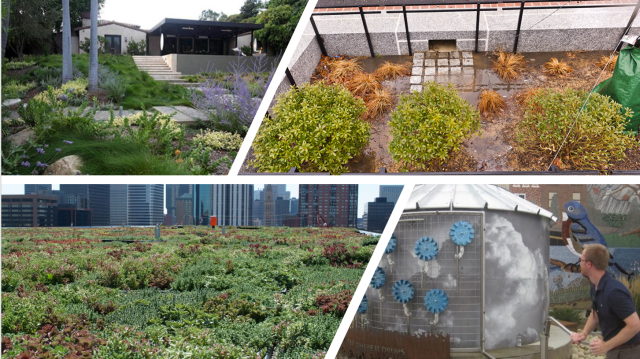
For many cities, stormwater Any precipitation in an urban or suburban area that does not evaporate or soak into the ground, but instead collects and flows into storm drains, rivers and streams. Stormwater is also called urban stormwater, stormwater runoff and polluted runoff. Increased development across the Chesapeake Bay watershed has made stormwater the fastest growing source of pollution to the Bay and its rivers and streams. management remains a significant challenge. In some cases, surges in stormwater after heavy rainfall events can overwhelm systems that manage combined sewage and stormwater. This can result in direct discharge of untreated human, commercial, and industrial wastewater into nearby waterbodies. Therefore, treatment of stormwater related pollutants may be required to minimize the impact of contaminants on the watershed.
EPA wet weather planning and stormwater management research focuses on managing stormwater and leveraging ecosystem services (the benefits we receive from nature) from greenspace and associated green infrastructure. Managing stormwater would also allow for management of flow for landform preservation, benthic community protection, and flash flood mitigation. EPA research is targeted at adaptation and adaptive management to address water quantity, water quality, impacts to groundwater, and topics related to cost, effectiveness, and incentives to ratepayers. The research will help states, municipalities, and utilities improve water quality, manage water quantity, and reduce flood frequency in the face of changing precipitation, especially in overburdened communities.
Leveraging Benefits from Greenspace While Managing Stormwater
EPA researchers are synthesizing existing models, methods, assessment data, and approaches to aid communities in stormwater management planning and practice. This includes evaluating the costs and benefits of green infrastructure, operation and maintenance issues, groundwater impacts, and stormwater storage. This research will demonstrate implementation of monitoring strategies for effectively managing stormwater at multiple scales.
What is Green Infrastructure?
Green infrastructure uses filtration A process for removing particulate matter from water by passage through porous media., infiltration The flow of a fluid into a substance through pores or small openings. Commonly used to in hydrology to denote the flow of water into soil material., and evapotranspiration The sum of evaporation and plant transpiration from the Earth's land and ocean surface to the atmosphere. Evaporation accounts for the movement of water to the air from sources such as the soil, canopy interception, and water bodies. Transpiration accounts for the movement of water within a plant and the subsequent loss of water as vapor through stomata in its leaves. to treat and soak up rainwater where it falls. A few examples include rain gardens, green roofs, and permeable pavement.
Research Focus
- Developing metrics, models and monitoring techniques to determine optimal green infrastructure placement and size for urban stormwater control for separate and combined sewer systems, while accounting for the many constraints in urban areas.
- Assessing, analyzing and quantifying stormwater quality and other socio-economic benefits of implementing green infrastructure and reducing polluted stormwater runoff.
Managing Stormwater in the Face of Climate Uncertainty
EPA research aims to improve the scientific understanding of how stormwater infrastructure is equipped to respond to uncertainty related to a changing climate and the effects on watersheds and sewersheds. EPA researchers are demonstrating implementation of monitoring strategies for effectively managing stormwater at multiple scales, and assessing resilience and adaptation efforts.
Research Focus
- Applying modeling approaches to assess the impact of extreme storm events in aging sewersheds and urban watersheds.
- Monitoring and assessing microbial pathogens and chemical risks in urban areas impacted by flooding events.
Monitoring and Managing Stormwater Recommendations and General Procedures
EPA researchers are creating standard procedures and practical methods to help communities across the United States understand how to manage their stormwater and estimate the costs of infrastructure strategies. This research reviews and incorporates climate change into major stormwater management tools and methods, green infrastructure planning and guidance, and Smart Urban Design tools for stormwater planning, stormwater capture, and aquifer recharge.
Research Focus
- Developing methods and techniques to help communities understand what characteristics to manage in their stormwater and how to measure them.
- Improving sensors and sampling technologies for monitoring water quantity and quality in stormwater.
- Assessing methods for remediation of tire-related pollutants in stormwater.
- Developing and advancing stormwater management models.
Related Research and Resources
Research
- Coastal Community Resilience Research
- Green and Gray Infrastructure Research
- Enhanced Aquifer Recharge Research
- Salt Research
- Stormwater Management Research (Emergency Response)
- Water Reuse Research
- Wastewater Research
Models and Tools
- Green Infrastructure Modeling Toolkit
- Stormwater Management Model
- National Stormwater Calculator
- EPA Science Models and Research Tools (SMaRT) Search
- Water Modeling Tools for Decision Support
Basics, Planning, and Partnerships
- More on Green Infrastructure: Soak Up the Rain
- EPA scientists partner with Florida’s Escambia County to study tire-derived pollutants in stormwater
Sustainable Communities
- Healthy Benefits of Green Infrastructure in Communities (pdf)
- Community Solutions for Voluntary Long-Term Stormwater Planning
- Lick Run: Green Infrastructure in Cincinnati and Beyond
- Using Economic Incentives to Manage Stormwater Runoff in the Shepherd Creek Watershed, Part I
- Urban Street Trees and Green Infrastructure
- Community Solutions for Voluntary Long-Term Stormwater Planning