U.S. flag

An official website of the United States government

Here’s how you know

Dot gov

Official websites use .gov
A .gov website belongs to an official government organization in the United States.

HTTPS

Secure .gov websites use HTTPS
A lock (LockA locked padlock) or https:// means you’ve safely connected to the .gov website. Share sensitive information only on official, secure websites.

    • Environmental Topics
    • Air
    • Bed Bugs
    • Chemicals, Toxics, and Pesticide
    • Emergency Response
    • Environmental Information by Location
    • Health
    • Land, Waste, and Cleanup
    • Lead
    • Mold
    • Radon
    • Research
    • Science Topics
    • Water Topics
    • A-Z Topic Index
    • Laws & Regulations
    • By Business Sector
    • By Topic
    • Compliance
    • Enforcement
    • Guidance
    • Laws and Executive Orders
    • Regulations
    • Report a Violation
    • Environmental Violations
    • Fraud, Waste or Abuse
    • About EPA
    • Our Mission and What We Do
    • Headquarters Offices
    • Regional Offices
    • Labs and Research Centers
    • Planning, Budget, and Results
    • Organization Chart
    • EPA History

Breadcrumb

  1. Home
  2. Great Lakes Monitoring

Great Lakes Fish Monitoring and Surveillance Program

The Great Lakes Fish Monitoring and Surveillance Program was established in the late 1970s. This program helps EPA meet obligations under Section 118(c)(1)(B) of the Clean Water Act to establish a Great Lakes system-wide surveillance network to monitor the water quality of the Great Lakes with a specific emphasis on the monitoring of toxic pollutants. Project outcomes include an increased understanding of long-term contaminant trends in Great Lakes top predator fish.

Background and Objectives

Fish are exposed to chemicals in water and from the food they eat. Since these species occupy the highest trophic levels of the Great Lakes food web, contaminants can bioaccumulate and biomagnify in their tissues over time. The GLFSMP analyzes contaminants in whole top predator fish (Lake Trout and Walleye) to assess Great Lakes ecosystem health.
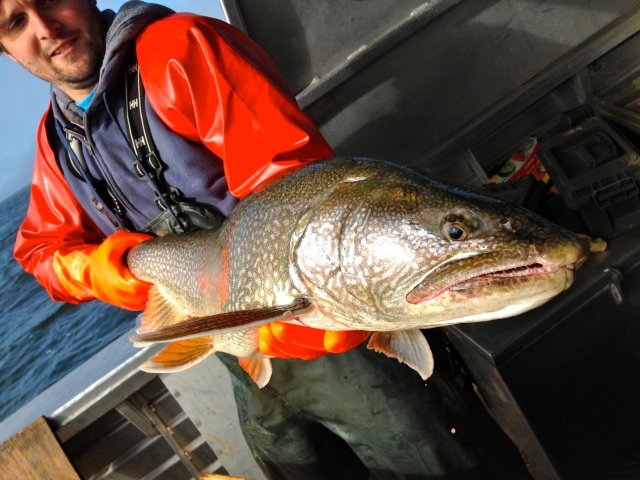
Lake trout caught at the Keweenaw Point Lake Superior sampling site. Photo Credit: Bill Mattes.
Lake Trout caught at the GLFMSP Keweenaw Point collection site in Lake Superior. Photo Credit: Bill Mattes.

Monitoring Locations

Great Lakes Fish Monitoring and Surveillance Program collection sites. This map opens to an image.

Fish are collected for the GLFMSP from each Great Lake annually each fall on an even/odd year rotation. The triangles designate even year collection sites, and the circles designate odd year collection sites. Lake Trout are collected at every site except for Middle Bass Island, where Walleye are collected.

Similarly sized fish (measuring 600 mm – 700 mm in length) are collected to target fish of a similar age range for analysis, since older fish generally are exposed to more contaminants than younger fish. In the lab, fish aging techniques using maxillary bones and otoliths are used to verify age.

Data and Trends 

GLFMSP data can be accessed via the Great Lakes Environmental Database on the EPA Central Data Exchange. The graphic below shows PCB concentrations in Great Lakes Lake Trout and Walleye over time from each collection site since 1991. Concentrations of PCBs in Lake Trout and Walleye have declined over time at all GLFMSP collection sites.

Mean total PCB concentrations (ppb) in Great Lakes Lake Trout/Walleye from 1991-2019 collected at GLFMSP sites. These graphs open to images.
Mean total PCB concentrations in Great Lakes Lake Trout/Walleye from 1991-2019 at GLFMSP collection sites.

Technical Reports

  • 2019 GLFMSP Technical Report
  • 2017 GLFMSP Technical Report
  • 2016 GLFMSP Technical Report

Related Information

  • Great Lakes Environmental Database via EPA’s Central Data Exchange 
  • Great Lakes Fish Monitoring and Surveillance Program Quality Documentation

Contact Information

Brian Lenell
(lenell.brian@epa.gov) 
312-353-4891 


Contact your local state agency for information about fish consumption advisories.

Great Lakes Monitoring

  • Great Lakes Monitoring
    • Great Lakes Water Quality Monitoring Program
    • Integrated Atmospheric Deposition Network
    • Great Lakes Biology Monitoring Program
    • Great Lakes Fish Monitoring and Surveillance Program
  • EPA's Research Vessel Lake Guardian
  • Great Lakes Coastal Wetland Monitoring Program
    • Why Monitoring of the Great Lakes Coastal Wetlands is Important
    • How the Great Lakes Coastal Wetlands are Monitored
    • Where Great Lakes Coastal Wetlands Occur
    • Great Lakes CWMP Results and Major Findings
    • How the CWMP Data are Being Used
Contact Us About Great Lakes Monitoring
Contact Us About Great Lakes Monitoring to ask a question, provide feedback, or report a problem.
Last updated on April 1, 2026
  • Assistance
  • Spanish
  • Arabic
  • Chinese (simplified)
  • Chinese (traditional)
  • French
  • Haitian Creole
  • Korean
  • Portuguese
  • Russian
  • Tagalog
  • Vietnamese
United States Environmental Protection Agency

Discover.

  • Accessibility Statement
  • Budget & Performance
  • Contracting
  • EPA www Web Snapshot
  • Grants
  • No FEAR Act Data
  • Plain Writing
  • Privacy and Security Notice

Connect.

  • Data
  • Inspector General
  • Jobs
  • Newsroom
  • Regulations.gov
  • Subscribe
  • USA.gov
  • White House

Ask.

  • Contact EPA
  • EPA Disclaimers
  • Hotlines
  • FOIA Requests
  • Frequent Questions
  • Site Feedback

Follow.