U.S. flag

An official website of the United States government

Here’s how you know

Dot gov

Official websites use .gov
A .gov website belongs to an official government organization in the United States.

HTTPS

Secure .gov websites use HTTPS
A lock (LockA locked padlock) or https:// means you’ve safely connected to the .gov website. Share sensitive information only on official, secure websites.

    • Environmental Topics
    • Air
    • Bed Bugs
    • Chemicals, Toxics, and Pesticide
    • Emergency Response
    • Environmental Information by Location
    • Health
    • Land, Waste, and Cleanup
    • Lead
    • Mold
    • Radon
    • Research
    • Science Topics
    • Water Topics
    • A-Z Topic Index
    • Laws & Regulations
    • By Business Sector
    • By Topic
    • Compliance
    • Enforcement
    • Guidance
    • Laws and Executive Orders
    • Regulations
    • Report a Violation
    • Environmental Violations
    • Fraud, Waste or Abuse
    • About EPA
    • Our Mission and What We Do
    • Headquarters Offices
    • Regional Offices
    • Labs and Research Centers
    • Planning, Budget, and Results
    • Organization Chart
    • EPA History

Breadcrumb

  1. Home
  2. Toxics Release Inventory (TRI) Program

TRI Photo Storybook

The Toxics Release Inventory (TRI) fotonovela (photo storybook) is an introduction to TRI that EPA produced as part of the TRI Community Engagement Initiative. It reflects input provided by residents of Jurupa Valley, California. A fotonovela is a small pamphlet that uses photographs and dialogue bubbles to depict a story in Spanish. 

  • TRI Photo Storybook (pdf) (9.62 MB, 10/2024)
The Diaz Family Learns That They Have the Right to Know About Toxic Chemicals in Their Neighborhood
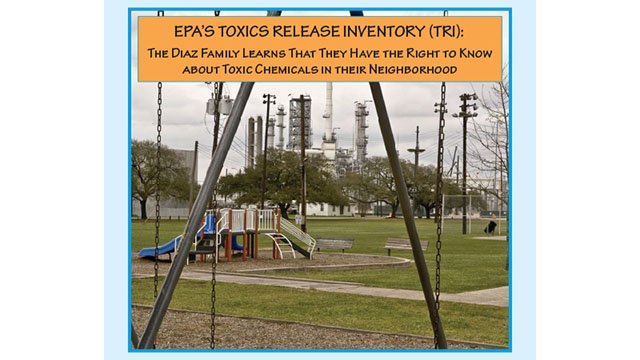
  • EPA's Toxics Release Inventory (TRI) - The Diaz Family Learns That They Have the Right to Know About Toxic Chemicals in Their Neighborhood - Image of a playground with swings and a jungle gym. In the foreground, right behind some houses, there is a factory.
  • Portrait photographs of the Diaz Family and Neighbors. Photographs include Julio, Johnny, Rosie, Cesar, Lupe, Dolores, and Miguel.
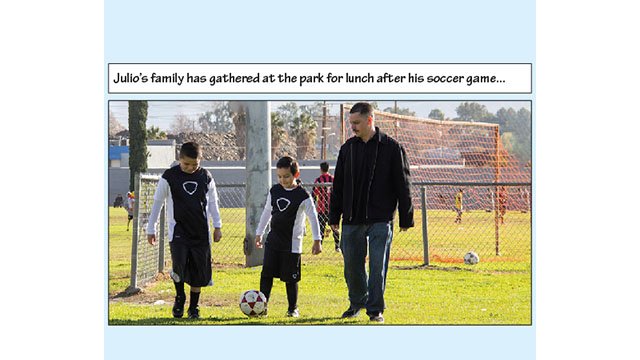
  • Julio’s family has gathered at the park for lunch after his soccer game. In this picture, Julio, Johnny, and Cesar are kicking a soccer ball around the soccer field at the park.
  • Rosie is watching Cesar, Julio, and Johnny kick the soccer ball. In this picture, Rosie is waving her arms very cheerfully and says "Wow Julio, you played really well!" Julio and Johnny pause playing and look at Rosie. In this picture, they have their arms down at their sides and look exhausted. They tell Rosie "Thanks, it was a hard game. I'm pretty hungry now!"
  • Rosie responds to Julio by saying "Don't worry Julio, we have lots of food here for you and your team". In this picture, Rosie is standing right next to a picnic table with food on it. There are two women standing next to the picnic table organizing the food on the table. Rosie is pointing her finger at the picnic table so Julio knows where the food is. Julio walks up to Rosie, and says "Hey, mom?" Rosie responds "Yes, Julio?". In this picture, we see Julio looking up at Rosie with his hands behind his back
  • In this picture, Julio is pointing his finger at a smokestack relatively close by. He asks Rosie "Who lives there? That's the biggest chimney I have ever seen!"
  • In this picture, Johnny turns his face to Julio and laughs. He responds "It's not  house, silly. It's a factory."  In this picture, Julio turns his head to Johnny and says "Why does a factory need a chimney?"
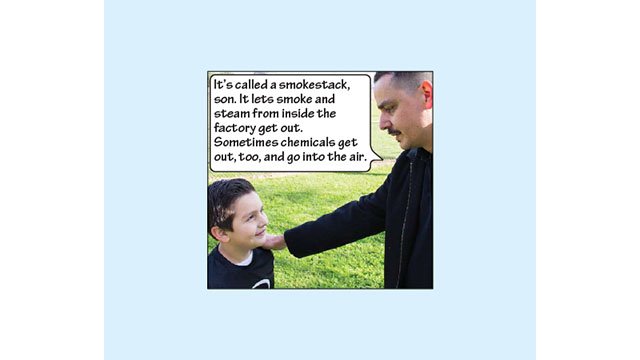
  • Johnny places his hand on Julio's shoulder. He explains to Johnny "It's a smokestack, son. It lets smoke and steam from inside the factory get out. Sometimes chemicals get out, too, and go into the air"
  • Delores is having a conversation with Rosie. Delores points toward the smokestack with her face turned to Rosie and asks "Rosie, do you wonder what's coming out of that smokestack?" Delores and Rosie look out to the factory. Rosie says: "Yes I do. This soccer field is super close to the factory and I worry about the safety of the kids".
  • This picture shows Lupe, Rosie, Delores, Johnny, Julio, and Cesar all looking at the closeby factory. Delores says: "I wish there was something I could do to learn more about that factory and other ones around here, but I don't know where to start".
  • This picture shows Rosie looking at Delores as Delores says: "It seems like we should have the right to know about what is coming out of factories in our neighborhood". This picture shows Miguel a few feet behind them listening.
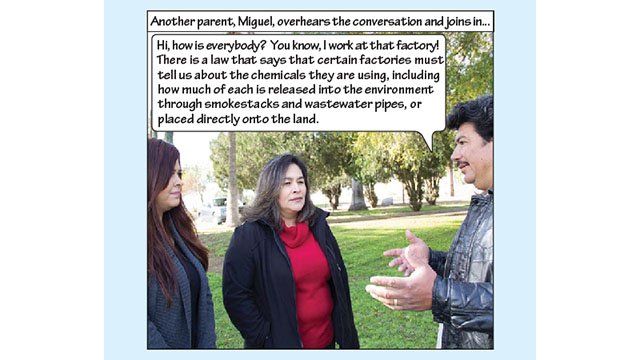
  • This picture shows Miguel with his hands standing right next to Delores and Rosie. Rosie and Delores are both looking at Miguel as he says: "Hi how is everybody? You know, I work at tht factory! There is a law that says that certain factories must tell us about the chemicals they are using, including how much of each is released into the environment through smokestacks and wastewater pipes, or placed directly onto the land".
  • Johnny looks up at Miguel in this picture, he is standing right next to Cesar. Julio is standing behind Johnny. Rosie and Delores are standing next to Johnny. Johnny exclaims to Miguel "But I don't see any smoke coming out of that smokestack."
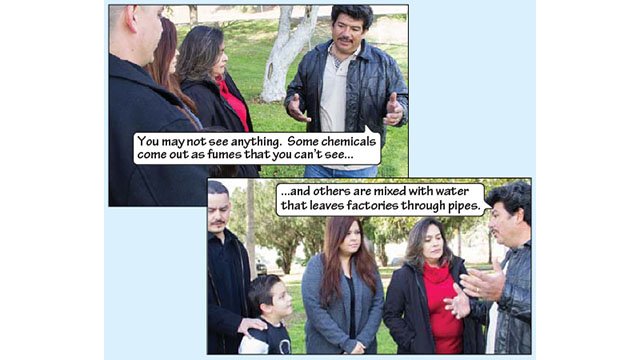
  • Miguel has his hands up in this picture, as he explains to the group: "You may not see anything. Some chemicals come out as fumes that you can't see." Miguel still has his hands up as he continues to explain: "...and others are mixed with water that leaves factories through pipes".
  • Delores and Rosie both look intrigued in this picture. Rosie asks, "But how can we find out about the chemicals that come out of the factory"?  Miguel is pointing at his phone in this picture, as he explains: "From a website run by the EPA called TRI! TRI stands for "Toxics Release Inventory." Congress created the TRI in the 1980s as part of the Emergency Planning and Community Right-to-Know Act.
  • This picture shows Migues with his phone up near his face as Cesar, Johnny, Julio, Rosie, Delores, and Lupe listen to what he is saying. Miguel says: "I can show you on my phone. You can look it up on a computer, too".  This picture is a zoomed in shot of Miguel's phone. Miguel says: Look all I do is go to www.epa.gov/tri, scroll to the bottom of the page, and I can type in our street address or search using our current location".
  • This picture shows Miguel flipping his phone to show Johnny and Rosie. Rosie says: "Wow! It shows a map of our whole neighborhood. See Julio, we're here and there's the factory where Miguel works".  In this picture, Johnny looks up at his mom, Rosie, and asks "What does it say, Mom?"
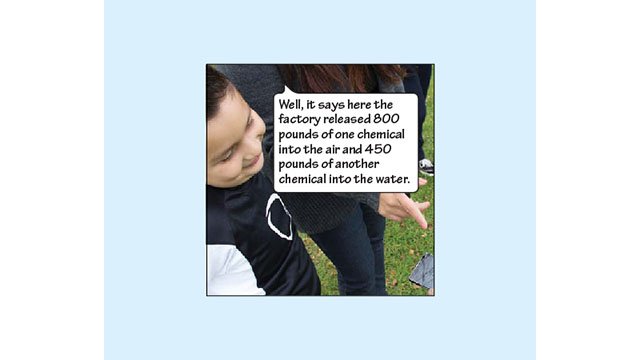
  • In this picture, Rosie and Johnny are still looking at Miguel's phone. Rosie says "Well, it says here the factory released 800 pounds of one chemical into the air and 450 pounds of another chemical into the water".
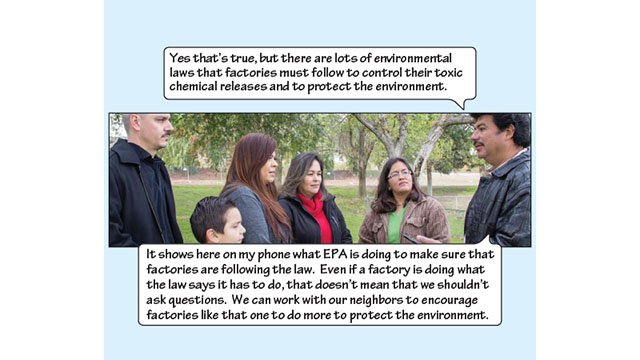
  • Miguel explains, “Yes, that's true, but there are lots of environmental laws that factories must follow to control their toxic chemical releases and to protect the environment. It shows here on my phone what EPA is doing to make sure that factories are following the law. Even if a factory is doing what the law says it has to do, that doesn't mean that we shouldn't ask questions. We can work with our neighbors to encourage factories like that one to do more to protect the envrionment.”
  • Rosie looks down at Johnny. Johnny asks: "Why does the factory use all those chemicals in the first place?" This picture shows Miguel explaining that: "Factories use chemicals to make cars, refrigerators, computers, and other things that we use every day".
  • Rosie, Lupe, and Delores look back at Miguel in this picture. Rosie says: "Miguel, won't those chemicals make the kids sick?" This picture shows Miguel responding to Rosie's question. He says: "Well, TRI tells us a lot about chemicals that come out of many factories. This is very important. But, it can’t tell us if those chemicals enter our bodies or cause health problems. That would require more information."
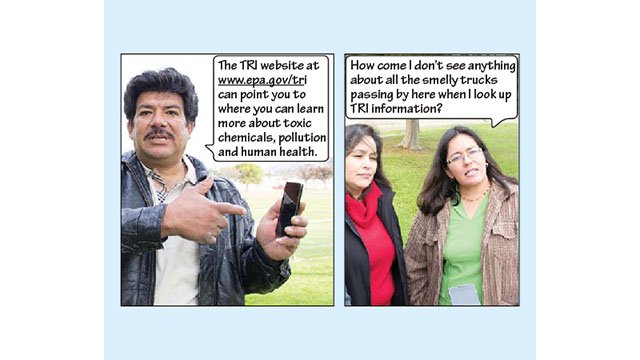
  • In this picture, Miguel is pointing at his phone. He explains: "The TRI website at www.epa.gov/tri can point you to where you can learn more about toxic chemicals, pollution and human health." Delores and Lupe look up at Miguel. Lupe asks: "How come I don’t see anything about all the smelly trucks passing by here when I look up TRI information?"
  • In this picture, Miguel looks at Lupe. He responds to her question: "TRI doesn't cover all types of pollution"
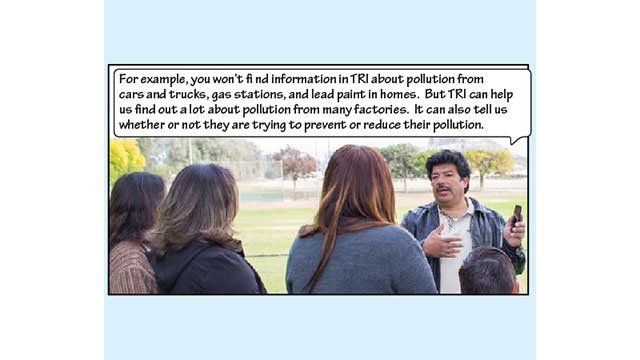
  • In this picture, we see Miguel has his phone up and is facing Lupe, Delores, Rosie, Johnny, Cesar, and Luis. Miguel says: "For example, you won’t find information in TRI about pollution from cars and trucks, gas stations, and lead paint in homes. But TRI can help us find out a lot about pollution from many factories. It can also tell us whether or not they are trying to prevent or reduce their pollution."
  • This picture shows Cesar, Rosie, and Johnny facing Miguel. Johnny says: "Thanks, Miguel. I'm going to use a computer at the library to learn more about this" This picture shows Johnny with his fist up. Johnny says: "We can talk to my science teacher, too. She knows a lot about environmental issues and she runs an environmental group in town."
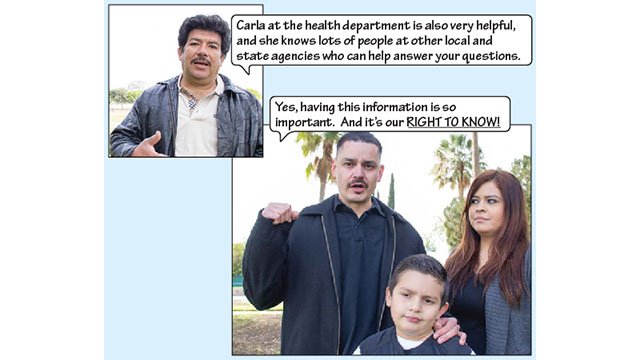
  • This picture shows Miguel still explaining to the group. He explains: "Carla at the health department is also very helpful, and she knows lots of people at other local and state agencies who can help answer your questions." This picture shows Cesar, Rosie, and Julio standing. Cesar's fist is up and he says: "Yes, having this information is so important. And it's our right to know."
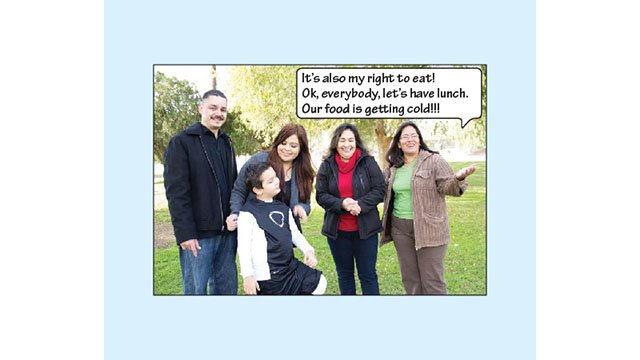
  • Cesar, Johnny, Rosie, Delores, and Lupe are in this picture smiling. Lupe says: "It's also my right to eat! Ok, everybody, let's have lunch. Our food is getting cold!!!"

For More Information

  • General TRI Program information: Toxics Release Inventory (TRI) Program
  • TRI information for communities: TRI for Communities
  • Contact your EPA regional TRI Coordinator: TRI Regional Coordinators
  • Email TRI Program staff at EPA Headquarters: tri.help@epa.gov

Toxics Release Inventory (TRI) Program

  • What is TRI?
    • Covered Chemicals
    • Covered Industry Sectors
    • Data Quality
  • Reporting for Facilities
    • Guidance (GuideME)
    • Reporting Software (TRI-MEweb)
    • Laws & Regulatory Activities
    • Enforcement
  • TRI Data & Tools
  • Pollution Prevention
    • Guide to Using TRI Data to Reduce Pollution in Your Community
    • P2 Analyses
    • P2 Resources
  • TRI Data in Action
    • Data Uses Catalog
    • TRI for Communities
    • TRI for Advocacy Organizations
    • TRI for Researchers
    • TRI for the Press
    • TRI for Industry
    • TRI for Government
    • TRI for Tribes
    • What You Can Do
  • TRI Site Map
TRI Program Contacts
TRI Program Contacts to ask a question, provide feedback, or report a problem.
Last updated on December 1, 2025
  • Assistance
  • Spanish
  • Arabic
  • Chinese (simplified)
  • Chinese (traditional)
  • French
  • Haitian Creole
  • Korean
  • Portuguese
  • Russian
  • Tagalog
  • Vietnamese
United States Environmental Protection Agency

Discover.

  • Accessibility Statement
  • Budget & Performance
  • Contracting
  • EPA www Web Snapshot
  • Grants
  • No FEAR Act Data
  • Plain Writing
  • Privacy and Security Notice

Connect.

  • Data
  • Inspector General
  • Jobs
  • Newsroom
  • Regulations.gov
  • Subscribe
  • USA.gov
  • White House

Ask.

  • Contact EPA
  • EPA Disclaimers
  • Hotlines
  • FOIA Requests
  • Frequent Questions
  • Site Feedback

Follow.