


TRI for Tribes
Industrial facilities located in Indian country that meet Toxics Release Inventory (TRI) reporting requirements must submit annual data to EPA and the appropriate tribal government entity. EPA makes the TRI data available online.
- How can Tribal communities use TRI data?
- How many TRI facilities are on Tribal lands?
- How can Tribes quickly get TRI information?
- What responsibilities and opportunities do Tribes have under the TRI Tribal Rule?
- Are Tribes at risk from toxic chemical releases on or near their lands?
- What help is available for Tribes concerned about toxic chemical releases?
How can Tribal communities use TRI data?
TRI data can help Tribes:
- Identify sources of chemical releases that may impact the health of their communities
- Track changes in chemical releases over time
Prioritize opportunities to reduce pollution from facilities located on or near Tribal lands
How many TRI facilities are on Tribal lands?
In 2024, there were:
- 353 facilities located on the lands of 44 federally recognized Tribes.
- Collectively, these facilities reported 33.5 million pounds of chemical releases.
- 2,075 facilities located on or within 10 miles of the lands of 240 federally recognized Tribes.
- Collectively, these facilities reported 240 million pounds of chemical releases.
Keep in mind that there may be facilities releasing toxic chemicals on or near Tribal lands that were not required to report to the TRI Program in a particular year.
View the list of facilities located on or within 10 miles of Tribal lands
How can Tribes quickly get TRI information?
Tribal Search
The search below provides interactive charts to easily access summary-level data about chemical releases from TRI facilities located on or within 10 miles of Tribal lands. If no selections are made, the tool will display national-level data for all Tribes.
TRI Toxics Tracker
Tribes can use TRI Toxics Tracker to:
- map the locations of TRI-reporting facilities on or within 10 miles of their lands,
- view customizable charts showing which Tribes have the most facilities on their lands, the largest amount of chemical releases, and other summary-level information, and
- determine if facilities on or near their lands have implemented pollution prevention practices.
What responsibilities and opportunities do Tribes have under the TRI Tribal Rule?
EPA finalized TRI Reporting for Facilities Located in Indian Country (i.e., TRI Tribal Rule) in 2012. A Tribe's only responsibility under the rule is to receive any TRI forms submitted by facilities located within its Indian country.
Under the rule, a Tribal chairperson or equivalent elected official has the same opportunities as a state governor to petition EPA to:
- request that individual facilities located within their Indian country be added to TRI, and
- request that a particular chemical(s) be added to or deleted from the TRI chemical list.
Are Tribes at risk from toxic chemical releases on or near their lands?
Many factors determine whether or to what extent releases of TRI-listed chemicals pose a risk to human health or the environment. The diagram below summarizes some of these factors.
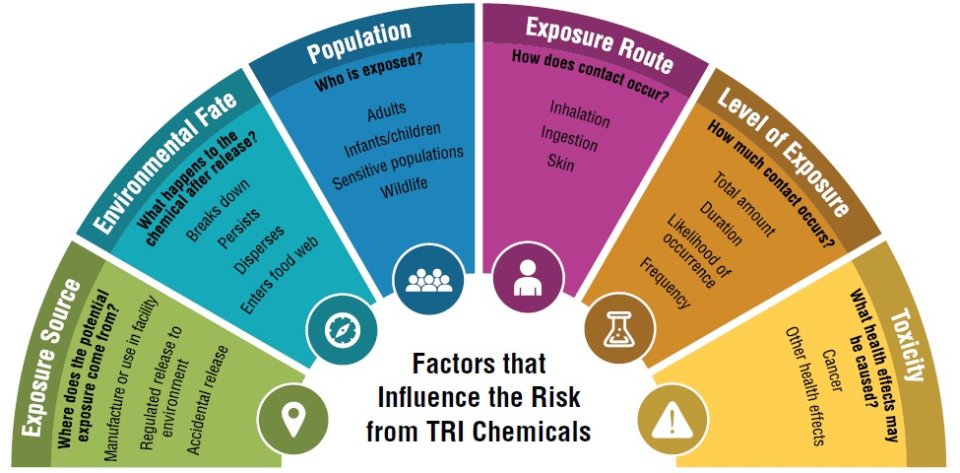
TRI has some of the information described in the diagram. The TRI provides estimates of how much of certain chemicals are released into the environment and indicate how those chemicals are managed prior to (or instead of) being released. This information can be used to identify potential toxic chemical hazards near tribal communities; however, release estimates alone are not sufficient to determine exposure or to calculate potential risks to human health and the environment.
You can learn more about potential health impacts from TRI-listed chemicals, or browse Factors to Consider When Using TRI Data.
What help is available for Tribes concerned about toxic chemical releases?
Tribal Contacts
- EPA TRI Program Regional Coordinators: Tribes concerned about toxic chemicals released from specific industrial facilities may contact the TRI Coordinator in their region.
- EPA Tribal Program Managers: Tribes are encouraged to contact the Tribal Program Manager in their region with questions about facilities near Tribal communities.
- TRI Tribal Contacts: Find the environmental officials designated by federally recognized Tribes to receive reporting forms from TRI facilities located on the lands of federally recognized Tribes.
Online Tools
- Report Environmental Violations: Tell EPA about suspected violations of environmental laws.
- EPA's Enforcement and Compliance History Online (ECHO) tool: Find out if a facility is in compliance with EPA laws and regulations.
- EPA's Risk-Screening Environmental Indicators (RSEI): The RSEI tool can help your tribe establish priorities for further investigation. RSEI incorporates TRI data on the amount of toxic chemicals released with factors such as the chemical’s fate and transport through the environment, each chemical’s relative toxicity, and potential human exposure.