


Tribal Communities
Under EPA policy, the agency works with federally recognized Indian tribesThose tribes federally recognized by the Secretary of the Interior. [40 CFR § 372.3] on a government-to-government basis to protect the land, air, and water in Indian CountryIndian country as defined in 18 U.S.C. 1151. That section defines Indian country as:(a) All land within the limits of any Indian reservation under the jurisdiction of the United States government, notwithstanding the issuance of any patent, and including rights-of-way running through the reservation;(b) All dependent Indian communities within the borders of the United States whether within the original or subsequently acquired territory thereof, and whether within or without the limits of a State; and (c) All Indian allotments, the Indian titles to which have not been extinguished, including rights-of-way running through the same. [40 CFR § 372.3] and Alaska Native villages and to support tribal assumption of program authority.
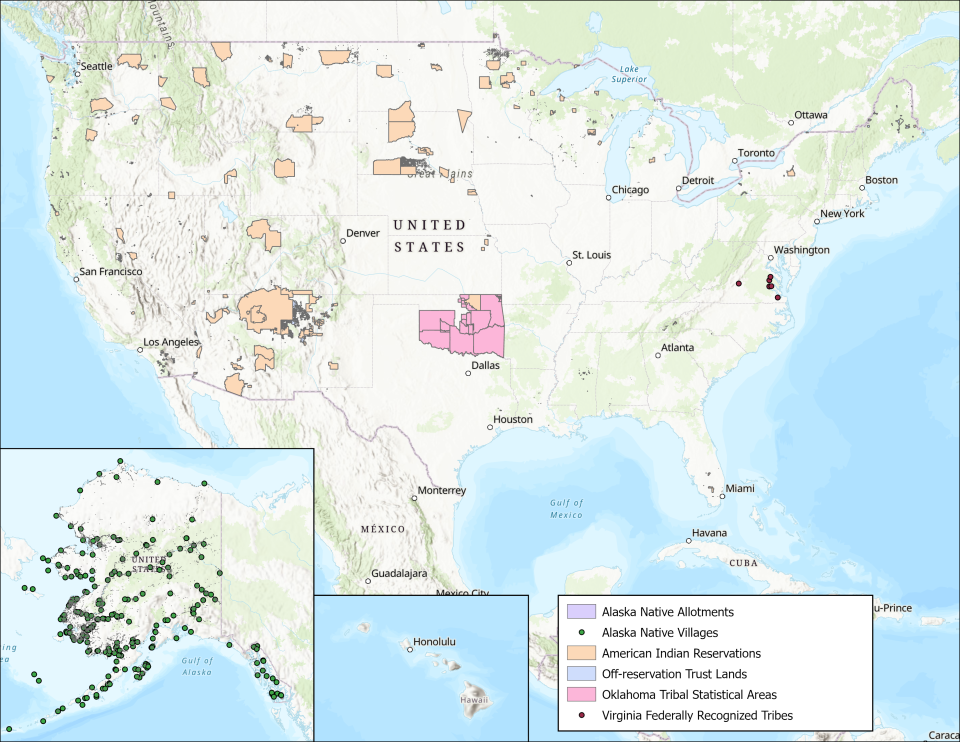
In 2023, 377 facilities located on the land of 47 federally recognized tribes reported to TRI. These facilities collectively managed 236 million pounds of waste, 32 million pounds (13%) of which were disposed of or otherwise released. Of these releases, 58% were disposed of on site by food, electric utilities, paper, and chemical manufacturing facilities. These facilities primarily released nitrate compounds, methanol, and ammonia, which accounted for 75% of on-site releases from these sectors.
Many more facilities are located within a 10-mile radius of tribal land. In 2023, 2,143 facilities on or within 10 miles of tribal land reported to TRI, representing 250 different federally recognized tribes. These facilities collectively managed 1.3 billion pounds of waste, 229 million pounds (18%) of which were disposed of or otherwise released. Of the releases reported, 61% were released on site by chemical manufacturing, primary metals, and metal mining facilities.
The table below provides more details about the types of releases and other waste management reported by facilities on federally recognized tribal lands.
Quick Facts for 2023: Facilities on Tribal Lands
| Measure | Facilities on Tribal Land | Facilities on or within 10 miles of tribal land |
|---|---|---|
| Number of Facilities that Reported to TRI | 377 | 2,143 |
| Number of Tribes | 47 | 250 |
| Waste Managed | 236 million lb | 1.30 billion lb |
| Recycling | 88.4 million lb | 489 million lb |
| Energy Recovery | 36.9 million lb | 150 million lb |
| Treatment | 79.5 million lb | 433 million lb |
| Disposal or Other Releases | 31.5 million lb | 229 million lb |
| Total Disposal or Other Releases | 31.5 million lb | 230 million lb |
| On-site | 25.3 million lb | 194 million lb |
| Air | 11.7 million lb | 59.5 million lb |
| Water | 4.79 million lb | 13.8 million lb |
| Land | 8.86 million lb | 121 million lb |
| Off-site | 6.21 million lb | 35.5 million lb |
Note: The amount of waste managed by disposal or other releases may differ from the amount shown as “total disposal or other releases” because several facilities reported managing large quantities of non-production-related waste, which is included in “total disposal or other releases” but not in “waste managed.”
The TRI Toxics Tracker is one way to explore information about releases and other waste management of TRI chemicals from facilities on or near tribal lands. Additional resources for tribes are available on the TRI for Tribes webpage, or use the interactive chart below to search for TRI data for facilities on or near tribal lands by tribe, chemical and/or industry sector.
You can also view a fact sheet for each tribe using TRI Explorer.
This page was published in August 2025 and uses the 2023 TRI National Analysis dataset made public in TRI Explorer in October 2024.