


Austin, TX: Festival Beach Food Forest
Old and new community members came together to grow a public food forest in an underserved neighborhood, providing free fruits and vegetables to all.
Brownfields Success Story
EPA Grant Type
Brownfields Assessment
Former Uses
Public Parkland
Current Use
Public Food Forest

East Austin is changing. Separated from downtown by a major interstate, the area has a troubled history of segregation, disinvestment and a lack of resources. Today, the city’s rapidly rising population is making property in the area more desirable—at the risk of displacing the existing community that has been there for generations. City planners, local organizations and residents needed to find a way to bring old and new members of the community together.
The Opportunity
When the city announced plans to redevelop the Edward Rendon Sr. Park at Festival Beach, residents from nearby neighborhoods started gathering informally to talk about what the park could become. The conversation turned to food production.
Local resident Jodi Lane was part of these early discussions: “We realized that we could connect as a community by utilizing public parkland near an existing community garden and senior center to produce food that is free for the taking, and in doing so, reinvent the Commons. A food forest would protect and enhance the natural beauty, tranquility and ecological health of the parkland, while also making fruit trees, edible plants and medicinal herbs part of the daily experience of neighbors and visitors, with no fences to exclude anyone.”
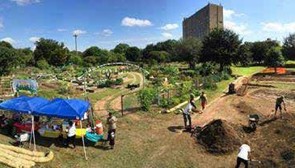
After a considerable effort by local advocates, the City Council unanimously approved plans to use two-thirds of an acre of Festival Beach parkland as a pilot for the food forest. But before construction of the forest could begin, the city wanted to make sure that the land was safe as a source of grown food. That the park’s shallow groundwaterbearing zone is near a gas station and the interstate was a particular reason for concern.
The Assessment
Awarded a Brownfields Assessment Grant from the U.S. Environmental Protection Agency, the City of Austin completed a Phase II Environmental Site Assessment, which concluded that there were no exceedances of regulatory screening levels for contaminants in the soils and groundwater. The food forest project could move forward without further environmental assessment and cleanup.
The Redevelopment
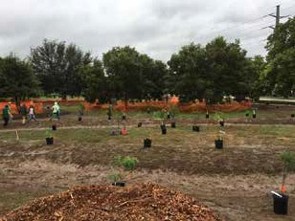
A local nonprofit stepped forward to become the fiscal sponsor of the Festival Beach Food Forest and helped procure federal grant funding. Volunteers and partnering nonprofits secured additional donated materials and provided the labor for the excavation and planting of over 100 fruit and nut trees. The City of Austin Neighborhood Partnering Program provided funds to help construct accessible trails, signage and benches.

In designing the food forest, planners took lessons from permaculture, an approach to landscape designs and livelihoods based on indigenous wisdom, modern technologies and observation of the natural ecosystem. Lane says, “We dug swales to capture the precious water we get in our dry Texas climate, and then used the excess soil to create a mound or ‘berm.’ We then planted cover crops and fruit and nut trees in the berms. It’s an edible landscape, resembling the riparian zone of a riverbed that helps sequester water to feed the plants and regenerate the soil at the same time.”
The Challenges
When the city began outreach efforts to plan for the redevelopment of East Austin, it aggravated many long-standing local residents, whose efforts to get city support for parkland improvements years earlier were unsuccessful.
Activists from a local community-based organization were the first to envision the Festival Beach Food Forest. Grounded in their neighborhoods’ heritage and inspired by the possibility of renewing relationships with the land and with each other, they gathered neighbors and allies in support of edible landscaping, accessible to one and all. Early on, members recognized that long-term accessibility was threatened by patterns of gentrification arising in East Austin. By locating the forest at the base of an independent living facility for seniors and people with disabilities, the coalition saw the opportunity to focus its impact in one of the only places in East Austin where the City of Austin has a long-term commitment to providing affordable housing.
Lane says, “It took us a good three years gaining the trust of the diverse neighbors and local organizations. Hosting respectful and inclusive community engagement events in community centers and backyard potlucks and earning the eventual endorsement of the neighbors and local leaders were crucial for the project.”
The novelty of the food forest concept in Austin presented another challenge. There was some pushback because the city did not know how to classify the forest. The team had to insist on its vision for the forest, its trees and plants, and its lack of fencing. Having some flexibility in the code or policy fosters innovation.
The Benefits
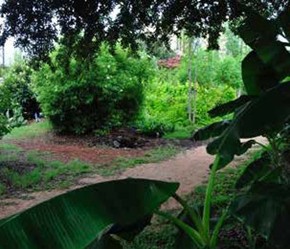
In what had been a field of Bermuda grass for many years now stands a forest with lush soil and colorful cover crops producing free food, a space for community celebrations and accessible pathways that local residents and seniors can use to visit the park.
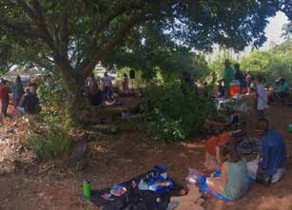
The shift in the idea of what constitutes public space is also valuable. People generally tend to view parkland as the city’s property. When, really, it is common space meant for the residents of that community. Now, thousands of people have come to steward the parkland.
The forest offers educational opportunities as well. Herbalists and foragers lead walks and talk about the different plants. Volunteers, community members, students and young people who have never engaged in farming or gardening learn how to harvest, make medicinal teas and eat straight from the ground—an impactful experience.
We realized that we could connect as a community by utilizing public parkland to produce food that is free for the taking, and in doing so, reinvent the Commons.
Jodi Lane
Co-Founder and Volunteer Lead
Festival Beach Food Forest
The benefits to the ecosystem of the area are many. Trees mitigate particulate matter and help improve the air quality and heat island effect in the area, which is warmer than its rural surroundings due to its proximity to the highway. Now, even during the hottest Austin summer day at the “pecan circle” in the center of the food forest, one feels a dramatic difference in temperature. Pollinators, beneficial fungi, Texas native prairie grasses and other wildlife species are contributing to the regenerative health of this special piece of parkland.
The Future
Project planners are gearing up to petition expansion of the plot by an additional three acres—and the forest is getting attention far beyond Austin’s city limits. Requests for information have come from as far as Germany. “People want to know how we built the forest,” Lane says, “from the permitting process, logistics and financials to the permaculture techniques and community-engagement processes.”
Leaders of the food forest are actively engaged in developing and documenting their model and vision of an inclusive Commons—a diverse, mixed-income, multi-generational and ecologically thriving neighborhood center. The food forest concept is an ancient one, drawing on indigenous practices of caring for the land and people. The team is interested in creating a model in which this wisdom finds solid ground in the city-making process of Austin and inspires other burgeoning cities to do the same.